
Of all the creatures that God created the only one that foresees and, therefore, fears death is the human being. Every other form of life on this planet accepts the natural cycle of death and life. I suppose the reason we fear death and postpone thinking about it until the very end, often only when we’re on our deathbeds, is because death is the entry into the great unknown. Many of us fear what we don’t know and can’t control.
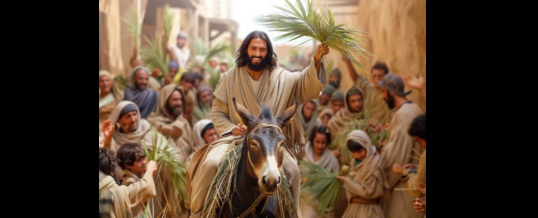
I know if I was in Jesus’ position, and the forces of darkness were closing in on me as they were closing in on him, I would be getting out of Dodge as quickly as possible. And I wouldn’t be taking a slowpoke donkey to do it. I would be grabbing the fastest horse available, saddle or no saddle. Instead of going into Jerusalem, I would be looking for the nearest escape route out.
As we just heard, Jesus didn’t do it that way. He heads right into the inevitable, the thing we all want to avoid—death. It’s like last Sunday’s gospel story of the Raising of Lazarus. Jesus is going to Mary and Martha because he heard their brother, Lazarus, was seriously ill. The disciples’ response was, “Rabbi, the people there were just now trying to stone you, and are you going there again?” The answer Jesus gives is, “Yes”. Why? Because he’s not going to let suffering and death dictate where he goes to offer God’s healing and life. By going into Jerusalem today, Jesus isn’t looking to become a martyr; he’s only looking to be faithful to God and God’s will. The first reading from Isaiah, although written 700 years prior, could easily be Jesus’ words when it says, “I have set my face like flint, and I know that I shall not be put to shame.”
Nothing is going to change Jesus’ mind. Nothing is going to force Jesus off the donkey. Nothing is going to change in his loyalty to the mission God gave him. Nothing is going to change Jesus’ mind about us, how he thinks about us, and how he loves us even if we don’t love in return.
Passion Sunday is more than just seeing Jesus as our hero. It’s about imitating his life, including the way he accepts death. We need to accept our deaths without shame or fear. If we believe in a life greater than this life, then we won’t fear giving up this life. But if we think death is the greatest and final force, then we’ll spend our lives fearing it.
Back in the Fall of 1983, I had the privilege of sitting in on a talk by Elizabeth Kübler-Ross, the world’s authority on death and dying. She was the Swiss-born American psychologist who gave us those five stages of grief that every person goes through whenever we have to face death of any kind. The stages are: denial, anger, bargaining, depression, and finally acceptance. She said, and I know it’s true, that once a person comes to terms with death, a certain peace and freedom comes over then. When that peace comes, even the offer of more time on this planet, is not something they want to be called back to. I think Jesus was at peace with his inevitable death.
A lot of what Elizabeth shared with us that evening was her work with dying children, especially children dying from cancer. Often these children would try to break the news of their impending death to their parents by giving them drawings and colorings. As children they didn’t have the words to express the fact that they were dying and had accepted it, so they drew and colored. Only a trained eye, like Elizabeth, knew what children were saying in their rudimentary artwork. Some children even took Elizabeth aside and would say, “Elizabeth, can you tell my parents that I am dying? I don’t think they’re mature enough to handle it from me.” And this is from 6,7, and 8-year olds!
People who are dying come to an awareness of what is real and what is unreal, what matters and what doesn’t matter. Unfortunately, most of us push off that enlightenment—and that’s what it is—until the last hours of life.
Fr. Richard Rohr says, “What religion is about, and what Jesus is exemplifying by going willingly to his death, is dying before you die. In fact,” he says, “I would go as far to say that the only function of religion is to teach you how to die before you die.”
Too bad we can’t get this message long before we are on our deathbeds. There is something much greater, much truer, and much deeper given to us than wealth, fame, and power. But we, unlike the animals, will fight it to the end.
So much of life as the spiritual writer Eckart Tolle tells us is illusion. Your life situation is not your life; it’s only your life situation. Unfortunately, the dramas of our life situations draw us in and take up so much of our energy. Learn what matters and what doesn’t matter. And the next time you get upset, usually about a drama that isn’t playing out the way you want it to, ask yourself, “Will this thing that’s upsetting me really mean anything in the long run?”
In the end, the great equalizer, for princes and paupers, for rich and poor, for presidents and janitors is death. And all the things we’ve grasped onto, all the things we thought were so important will pass away. And then we have to say, “Who am I now? Who am I now? Who am I now?”
Jesus marches into Jerusalem with his face set like flint knowing full well death will soon come. Like him, we have to trust in a bigger life. Apparently, we don’t really know what life is until we’ve faced our own death. This Holy Week, let’s do like Jesus and face death ahead of time. It’s not morbid, tragic or sad to do so. If we face it now, as Jesus did, we will have nothing to fear.
~Fr. Phil
MAR
2026
About the Author: