
You might remember how the Passion story ended last Sunday, on Passion Sunday (Palm Sunday). After Jesus is crucified, he’s placed in a tomb. Matthew, the gospel writer, throws in this little hint that Mary Magdalene and the other Mary sat opposite the tomb. This is a clue of what is to come. Pretend you never heard the story and have no idea that it ends in resurrection. Mary Magdalene isn’t just sitting anywhere; she’s sitting opposite the tomb. What is the tomb? The place of death. What is the opposite of death? Life. Mary Magdalene’s hunch is that the prophecy of Jesus, that he will be raised on the third day, may very well come true. By sitting opposite the tomb, she is not only living in hope but also showing her belief that Jesus is someone who keeps his word. He’s the faithful one.
Even with Jesus dead and safely secured in a tomb, the chief priest and Pharisees foresee a problem. They need to stop it now before it become a big problem. They remembered that this “imposter” said that he will rise again after three days. Now that he’s dead, his disciples might steal the body and start telling people that he has been raised from the dead. Pilate responds by sending soldiers to guard the tomb. It is not enough to kill Jesus; the religious and political authorities must keep him dead. Otherwise, in their fearful minds “the second deception will be worst that the first.”
Come back now to tonight’s gospel reading, again from Matthew. It begins with more clues, more hints. Mary Magdalene and the other Mary, the two who sat opposite the tomb after Jesus’ burial, have returned. They go to the tomb on the first day of the week at dawn. The first day of the week reminds us of the first day of creation. Dawn is not the full light, but a hint of the light that is coming. The first day of the week is the beginning of creation, and the first thing God creates is light. By coming to the tomb on the first day of the week at dawn, the world is about to be reborn.
As the two Mary’s get to the tomb, an Angel of the Lord, who likes to make scenes, appears in the midst of a great earthquake. The angel rolled back the stone that was sealing the tomb and sits on it. Sitting is the posture of the teacher, the one who has authority. By sitting on the huge stone, the tomb of death becomes the throne of God. God is still in charge and has authority over all things, even over death.
The appearance of the angel, we are told, was like lightning and his clothing white as snow. The only other time Matthew mentions that someone’s clothing became brilliantly white was when we heard the story of the Transfiguration, on that second Sunday of Lent. We were told that as Jesus was transfigured, his clothing became dazzling white. The Transfiguration was an advanced showing of what was to come—Jesus’ own resurrection.
The fear of the Angel sitting upon the stone caused the guards to become like dead men. The very ones sent to keep Jesus dead have themselves become like dead men. The stone, the guards, all pitiful human attempts to stop destiny cannot thwart the purposes of God.
Fear, from the Angel’s appearance, does not paralyze the women; they are energized. But fear does send the guards into catatonic shock. The Angel says to the two Mary’s, “I know you are looking for Jesus who was crucified. Sorry, but I can’t accommodate your wish. Jesus has much bigger plans for you two. You don’t get the dead Jesus. What you get instead is a mission, a mission from God. The mission is to go and tell the disciples that Jesus has been raised from the dead. He’s not here, and he’s not dead. He’s out there in the world, and he’s very much alive. Tell the other disciples that Jesus is gone ahead of you to Galilee; there you will see him.”
Why Galilee? Probably because Galilee is where the whole thing started. It started as a seed planted in the hearts of four simple fishermen who longed for something more in life. Have you ever longed for something more in life? Andrew, Peter, James, and John, as successful as they were being fishermen, just knew there had to be more than a dog-eat-dog world where many people are not alive but merely existing. They yearned to hear someone say, “I came that you may have life and have it to the full.” And it was from Jesus’ mouth that the invitation came. There was no looking back. From Jesus they received their mission to proclaim God’s love to the world. Down to this very day, that is the first and most important vocation of every Christian—to proclaim God’s love to the world.
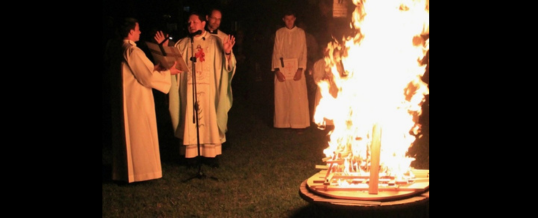
My dear elect, Bev, Isaac, and Greg, as well as candidate Renate, you four have also received a mission from God. It started much like the desire in the hearts of those fishermen 2000 years ago, probably the size of a mustard seed. With the help of your sponsors, the faith community, the R.C.I.A. team, and mostly through your own commitment, the Holy Spirit has brought you to this day.
God’s Angel appeared at the tomb as a messenger sent from God for the two Mary’s. When the Angel’s job was done, the women themselves became the new messengers, who told the disciples that Christ was risen. In turn, those disciples also became messengers to other disciples who told yet other disciples. And, now, we tell you. Bev, Isaac, Greg, and Renate go to the various Galilees of your world and tell everyone you know that Christ has not disappeared into death or into God. He is alive and present in anyone who still holds out hope. He is alive and well in everyone who sits opposite the tomb. He is alive and well in everyone who has ever desired to hear the words, “Come and follow me. I have come to give you fullness of life.”
~Fr. Phil
APR
2026
About the Author: