
All throughout these 50 days of Easter, our first reading will come not from the Hebrew Scriptures (Old Testament), but from the Acts of the Apostles. The Acts of the Apostles are stories about the beginnings of the Church and how the Early Church survived and thrived under the influence of the Holy Spirit, the Spirit promised and delivered by Jesus.
Today’s first reading speaks about how the early Christians came together for the breaking of the bread (Eucharist) and prayers. They sold what they had, pooled their resources, and helped anyone who was in need. This tells me that they stopped doing one thing and started doing another thing. They stopped going to the empty tomb expecting to find Jesus there, dead or alive. They started looking for his presence in the world. In sharing stories about what Jesus taught and what he did, they must have remembered that Jesus commanded them to feed the hungry, give drink to the thirsty, clothe the naked, and to visit the sick and imprisoned. And that if they did those they would be finding and serving him out there in the world, in every human being they encountered. That’s what the early Christians did, they responded to the needs of people out there and, day by day, the Lord added to their number. Wow! All that without university courses, theology classes, or a hierarchy of clergy.
These early Christians must have also believed in what was written in that second reading where St. Peter writes, “Although you have not seen him, you love him; and even though you do not see him now, you believe in him.”
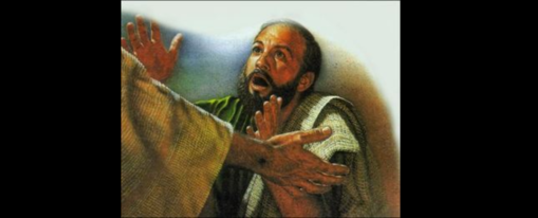
Then we get to the Gospel and meet up with someone who has his difficulties believing. His name is Thomas, and he is in quite a conundrum. Thomas is doubly unbelieving by refusing to accept the word of his brother apostles and by demanding a personal experience of the Risen Lord. Maybe Thomas gets a bum rap for his lack of faith, but I like him anyway. His pattern of coming to belief is something I can relate to. He might be doing it better than we ever expected. Thomas is about making connections. If he cannot make a connection between the crucified Jesus and the risen Jesus, then he refuses to believe. He will not believe too soon or too easily. I always feel more alive when I make a connection in my faith. When I can make a connection between a gospel story or a teaching of the Church and what’s going on in my personal life or the life of the world, it feels like a eureka moment. It’s like I’ve grasped a deeper level of a mystery that has eluded me up until now. It’s an ah-ha moment.
Thomas, similarly, needs to make connections and not just take other peoples’ word for it. If the crucified One and the risen One were the same person, then he needed to not only see the wounds of Christ but also to touch them, to experience the crucified risen one.
Are we not also a lot like Thomas? You can tell me about a good wine you’ve tasted recently, and I’ll believe you. But what I really want is to experience what you experience by tasting the wine myself. Similarly, you can describe a wonderful concert or musical you’ve been to. But what I want is to experience it myself. Until then, it’s only your connection and not yet mine. I tell people who are joining the Church through the R.C.I.A. process that it’s all about making connections. It not about learning more theology in your head; it’s about making connections with the people in the pews. We, as R.C.I.A. team, don’t make the connections for them. They make the connections between their faith and their lives with the help of the Holy Spirit. The Spirit is always breathing on us and bringing us the peace of Christ.
I like Thomas for another reason. He tells us, through his own struggles, that faith is not the exclusion of any and all things that cause us to doubt. Doubt is part of Thomas’ coming to faith. Be careful of people who never doubt and seem to have an answer for everything. They are usually people who have not walked any journey at all. They simply stay at home and remain in a world of certitudes and personal convictions and never leave. They are kind of like the Apostles locked in the upper room.
Faith is not about knowing that God exist, or that this or that truth is absolutely true. Faith is about a living, growing relationship, the kind of relationship Thomas was seeking—no, demanding—as a test of whether the resurrection was authentic or not. Thomas enters into the experience and from within the experience, cries, “My Lord and my God!” It’s an act of faith unmatched in the whole New Testament. It changes forever the direction of his life.
Those who are entrenched in their own certitudes, modern-day Pharisees, never proclaim, “My Lord and my God.” Why would they if they feel we have all the answers? When people are talking about right and wrong, as if they have the absolute and final say about it, and when they stand too proudly upon the ground of their own convictions, they usually turn people against people. God neither desires nor needs the protection of human absolutes.
“Blessed are those who have not seen and yet have come to believe,” Jesus says after Thomas’ outburst of faith. We may not come to see as Thomas saw, but we still have a need to experience the risen Lord if we are to come to faith. Without seeing, where do we meet the Lord so as to believe in him? Why not right here?
“Jesus did many other signs that are not written in this book,” John tells us. There’s a wonderful tradition about how Thomas gave his whole life to the gospel and established the faith in India. He himself became the sign. Is it stretching it too far to think that we could be signs to each other, living invitations to faith?
On a personal level, whenever someone shares with me their wounds–and we all have them–their stories resonate within me and I make a connection between their life story and the story of Jesus, the risen One. It’s also an invitation for me to be vulnerable before them and dare to share my own wounds. I’m more and more convinced that while sharing our gifts, our talents, and our strengths, we can accomplish more, yet I’m even more convinced that when we dare to share our wounds with each other we experience Christ, the Wounded One, in our midst. Community is built by wounded people being honest and vulnerable in front of each other. By touching each other’s glorious wounds, we open up belief in the ultimate victory of God’s love for the world.
~Fr. Phil
APR
2026
About the Author: