
It’s much easier to appreciate the glory of Jesus’ resurrection than his painful crucifixion. Yet, Mark’s Gospel, written around 65 to 70 AD, focuses on Jesus’ “suffering servanthood.” Christians believe that we are “saved by the death and resurrection of Jesus.” The key is to put both together. We need to deeply trust and allow both our dyings and our own certain resurrections, just as Jesus did! This is the full pattern of transformation. If we trust both, we are indestructible. That is how Jesus “saves” us from meaninglessness, cynicism, and violence—which is indeed death.
God is Light, yet this full light is hidden in darkness (Jn. 1:5) so only the sincere seeker finds it. It seems we must all go into darkness to see the light, which is counter-intuitive for the ego. We resist this language of “descent” and overwhelmingly made Christianity into a religion of “ascent,” where Jesus became a self-help “saviour” instead of a profound wisdom-guide who really transforms our minds and hearts.
In recent centuries, reason, medicine, technology, and efficiency have allowed modern, middle- and upper-class people to rather “successfully” avoid the normal and ordinary “path of the fall.” Yet the perennial and mature tradition of all world religions, and even the modern addiction recovery movement, believes that growth comes through some form of “falling upward,” not climbing upward, which is all about the ego.
Many of the happiest and most authentic people I know love a God who walks with crucified people and thus reveals and “redeems” their plight as God’s own. For them, God is not observing human suffering from a distance but is somehow in human suffering with us and for us. Such a God includes our suffering in the co-redemption of the world, as “all creation groans in our great act of giving birth (Rom. 8:22)
Is it possible? Could it be true that we “make up in our bodies all that still has to be undergone for the sake of the Whole Body” (Col. 1:24)? Are we somehow partners with the divine? Of course we are! In fact, I think that’s the whole point. The mystic knows there is only one suffering and we all participate in it together: the eternal suffering love of God.
Jesus takes on our suffering, bears it, and moves through it to resurrection. This is “the paschal mystery.” We too can follow this path, actively joining God’s loving solidarity with all suffering since the foundation of the world. Jesus does not ask us to worship him. He asks us to follow him by trusting and allowing this risky but revealing journey.
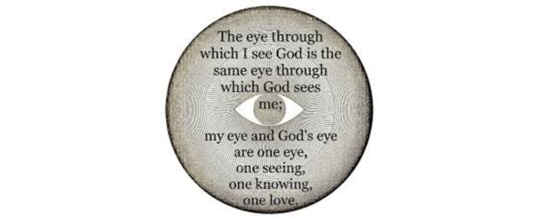
When I was young, I was taught that in heaven we would look at God for all eternity (the “beatific vision”). This sounds rather boring to a little boy. Perhaps heaven is not seeing God for all eternity but seeing like and with God for all eternity.
(Quoted from Fr. Richard Rohr)
APR
2026
About the Author: