
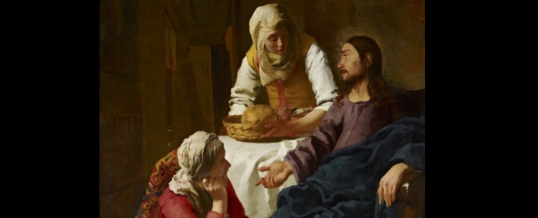
Like all gospel stories, this Mary and Martha story has many layers to it. Let’s pull back a few layers and see what it has to say to us. If it is the Word of God—the living Word of God–it should be as relevant now as it was 2000 years ago.
Layer one. I’ll just call it “Mary’s gutsy move.” Actually Mary doesn’t move at all; she sitting on her duff while Martha is doing all the work. There are two risk-takers in this gospel story, Mary and Jesus, and they’re both sitting. This classic story was traditionally seen as Jesus preferring the contemplative life (Mary sitting at Jesus’ feet) over and against the active life (Martha busy in the kitchen). And the justification for thinking this way came from Jesus’ praise of Mary and correction Martha when he said, “Mary has chosen the better part, which will not be taken away from her.” We took that to mean that the vocation of priests, brothers, nuns, religious sisters—the so called “contemplatives”—had a vocation preferred by Jesus. The rest of you didn’t really have a calling, so you had to hang out at the local tavern and come home with the best catch you could find! (This wasn’t always to Mamma’s liking). I do believe everyone has a calling, and that this story cannot be reduced to contemplation being preferred to action. If contemplation is preferred to action then we better get rid of last Sunday’s gospel story about the Good Samaritan who does so much, in the world of action, for the wounded man in the ditch.
I think what these risk-takers, Mary and Jesus, are doing is challenging cultural norms. In Biblical times, and for a long time after that, women were not expected to sit in the living room (the men’s domain) and engage in “intelligent” conversation. They were expected to be in the kitchen preparing meals and keeping the house tidy. Martha is trying to get Jesus to reinforce her cultural understanding of women’s roles, but Jesus refuses to do it while still affirming Martha. Martha even tries to get Jesus to do her bidding for her by saying, “Lord, don’t you see what’s going on here? My sister has left me to do all the work by myself. Tell her to help me.”
Although there will only and always be 12 Apostles, Jesus envisioned many disciples follow him, both men and women. A disciple, in any tradition, sits at the guru’s feet and learns from the master in order to, someday, follow in the master’s footsteps. Jesus is passing on his teachings, and Mary, like a faithful disciple, is all ears. She’s gutsy and is to be praised. Inwardly, she is saying to herself, “As important as the various tasks of life are, nothing is as important than listening to Jesus. That’s how I’ll become his follower, his disciple.” Mary, you might say, is grounded in God where Martha is grounded in the many tasks that she thinks is so important. Martha is a multitasker long before the word “multitasking” came into vogue. While Mary is a risk-taker, so is Jesus. He breaks the cultural norms in three ways. He is alone with Jewish women who are not his relatives, he allows a Jewish woman to serve him food, and lastly Jesus teaches a woman in her own home. This might not shock us, but this was scandalous and against all rules in Jesus’ time. The status quo is no longer. There is no separation between men and women between living room and kitchen. By Jesus telling Martha that Mary has chosen the better part, Jesus has in essence broken with Jewish law.
I called layer one of this story “Mary’s gutsy move.” I’ll call layer two “My heavy heart.” This story of Mary and Martha is only found in Luke’s gospel. Luke’s gospel is one, great, long, agonizing journey of Jesus to Jerusalem. What’s Jerusalem? The place where Jesus will enter into his passion and lay down his life for the world. Each chapter in Luke’s gospel brings Jesus a little closer to his suffering and death in Jerusalem. Every time he broaches the subject that the Son of God must go to Jerusalem suffer, die and be raised to new life, the Apostles want to hear nothing of it and try to change the subject. Mary, who sits at his feet, is different.
We’ll never know what Jesus said to Mary. All we know is that she sat there, listened, and took it all in. Maybe Jesus didn’t say anything except this, “Mary, my time is drawing to an end. Soon I will have to surrender my life. My closest friends don’t understand the heaviness of my heart. Will you just sit here with me? I don’t need you to say anything. Just sit and listen. That’s the best thing you can do for me right now. Your sister, Martha, is worried about how the house looks and whether her meal will meet with my approval. She has no idea, like the Apostles, how torn I am inside. I don’t condemn her for it, but I just know that you—in this my moment of need—have chosen the better part.” Mary nodded, was all ears, and became Jesus’ confidant and disciple in that moment.
A close friend of mine recently shared with me the news that he has stage 4 cancer that is spreading. The Martha in me wants to rush in and rescue him…like as if I can. The Mary in me knows that the best thing I can offer him is to sit at his feet and listen to the words that come from the heaviness of his heart. Like Jesus, I’m sure he’s contemplating his mortality. His heart is heavy. He doesn’t need a tidy house and a seafood casserole. He needs a listening ear. Anyone who provides that will be imitating Mary and hopefully hearing the praise of Jesus who says, “You, in this man’s moment of need, have chosen the better part.”
The third layer of this story I’ll simply call “Holding it all together.” Before we become too hard on Martha and people of action, let me just say that we are ultimately known by our action. “By your love, and nothing else, will the world recognize you as my disciples” (Jn. 13:35). Mary and Martha are sisters which, in spiritual teaching, means they symbolize side-by-side realities that are meant to be held together. They are two sides of the same coin, and we don’t dare separate them. Separating them or playing one against the other is to diminish both. Mary has to be our starting point. Prayer, sitting at the feet of Jesus each day, is what grounds us. If we’re not grounded, we become busybodies and not disciples. We run from one thing to another hoping to be helpful but not being anchored in Jesus. Remember, the point of sitting at the feet of Jesus is like participating at Mass where we eventually go to continue the mission of the Master, even if he is no longer physically present. When St. Paul wrote that we should “pray constantly” (1 Thes. 5:17), I don’t think he meant for us to be on our knees 24 hours a day. I think Paul was thinking of the Mary and Martha story. To pray constantly means to be about our many tasks during the course of the day always with an awareness of God. When we start with mentally grounding ourselves in God, our actions will automatically flow from that grounding, so our actions will also be grounded. A little story to illustrate this.
Here’s a story from the Hindu tradition. There was a king named Akbar who had a brilliant and clever prime minister named Birbal. Akbar, the king, was always testing Birbal. One day he asked Birbal to bring him someone who is Here but not There. Birbal went out and returned to the king with a thief saying, “This thief is only in the world to get money and steal property. He cares only about himself Here but not There.”
“Very good,” said the king. “Now I want you to bring me someone who is There and not Here.” So, Birbal went off and returned to the king with a monk saying, “This guy neglects all aspects of this world including his body and his wellbeing, to focus on the world beyond. He is definitely not Here but totally There.”
“Very good, very good,” said the king. “Now I want you to bring me someone who is neither Here nor There.” Off went Birbal who came back with a beggar. He said, “This beggar is not Here for he is not envious of anyone else in the world. He’s also not There for he has no concern for spiritual matters. Thus, he’s neither Here nor There.”
“Very good, very good, very good,” said the king. “Now, is it possible that there is anyone in the world who is both Here and There?”
“Yes, your majesty,” answered Birbal, and he brought forth an honest household couple. “This man and woman work in the world and tend to their family but do everything with God in their thoughts. Therefore, they are both Here and There.
“Very good, very good, very good,” said the king. After that he thought about the next challenge he would give to Birbal.
Start with being fully Here, fully present, and the “There” will look after itself. Grounded thoughts lead to grounded actions.
~Fr. Phil
JUL
2025

About the Author: