
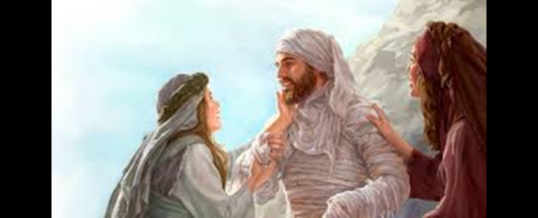
I’m beginning to appreciate the importance of the gospel stories we’ve had over the last three Sundays. Like I mentioned last weekend, in the Early Church, a person could not be baptized unless they were familiar with the story of the Samaritan Woman at the Well (two Sundays ago), the story of the Man Born Blind (last Sunday), and today’s story of the Raising of Lazarus from the Dead. With each story we get a little bit closer to the truth of who Jesus is and why he’s important for our lives. Hopefully, as we get older our understandings of Jesus is also maturing, growing, and deepening in us.
You might remember two weeks ago the Samaritan woman who came to draw water saw Jesus as a sir (“Sir, you don’t have a bucket, and the well is deep”). As the conversation goes on, she realized he was a prophet. Finally, she recognizes that the one speaking with her is, indeed, the long-awaited Messiah. She goes from sir to prophet to Messiah.
Last weekend, you might recall that the blind man’s path to understanding who Jesus is also came about in stages. First, he just refers to Jesus as some man named Jesus. “A man named Jesus put mud on my eyes.” Then he understands Jesus to be a prophet. Thirdly, he realizes this guy named Jesus is from God. Then he understands Jesus to be the Son of Man. And finally he calls Jesus, Lord. Just like the woman at the well, the blind man gradually understands a deeper and deeper truth about who Jesus is.
It’s our journey of faith as well and not just something that happened to two individuals 2,000 years ago. When you’re seven years old, it’s fine to believe in a God who is like a vending machine. You drop in your prayer, much like putting money in a vending machine. You give the handle a couple of cranks and out comes the answer to your prayer. That’s fine to imagine God like that when you’re seven. But, when you’re 67, and you’re still praying to the gumball deity, then we need to have a serious talk.
The woman at the well along with the man born blind come to their own conclusions of who Jesus is. And they do it in the best way possible, not by reading a book or taking a course, but by trusting in their own lived experiences. Through an experience that was unique to each of them, one of them concluded that Jesus is the Messiah and the other one determined that Jesus is the Lord. Not bad theology for a couple of 1st century country bumpkins!
But in today’s gospel, it is not someone else telling us who Jesus is; it is Jesus, himself, revealing to us who he is. We’re getting it straight from the horse’s mouth. Jesus says to Mary, Martha and the other mourners, “I am the resurrection and the life.” He is life itself, the one and only life there is. He has power not only over death but also over our fear of death.
Martha sort of gets it but also doesn’t get it. She’s a lot like most of us. Martha’s not too pleased with the fact that Jesus didn’t immediately come to them when he first heard that Lazarus was seriously ill. As the story tells us Jesus, after hearing that Lazarus was ill, chose to stay two days longer where he was. Martha shows her disappointment by saying, “Lord, if you had been here (instead of waiting for last call at the tavern), my brother would not have died.” A little later on Martha’s sister, Mary, will say the exact same words to Jesus, expressing the same disappointment.
When Jesus tells Martha that her brother, Lazarus, will rise again, her response is, “Ya, ya, ya, I know he’ll rise on the last day.” She has some kind of theology, a theology about the end time, going on in her head. How Martha thinks about “the last day” is probably like the way most people think of the last day, as some mysterious, unknown time in some distant future. Jesus has to correct her as he probably needs to correct many of us. He does not say, “I will be the resurrection sometime in the future, so stay tuned and, in the meantime, lead a life worthy of resurrection.” Instead, he speaks in the present tense by saying, “I am the resurrection.” Resurrection is not some future happening. It is present in Jesus right now. It’s not just something that appears when we need it, like when we draw our dying breath. Right here, right now, you are in the presence of the only life there is. You are in the presence of God. God is giving God’s eternal life to us in this very moment. It’s a continuum, one continuous flow of life in our direction.
So, Mary and Martha, like the Samaritan women and like the man born blind, are invited to discover the deeper identity of Jesus. As Jesus is patient with them, he is also patient with us. It’s almost as if Jesus is affirming what we believe about him yet also constantly inviting us to go deeper. Mary and Martha wanted Jesus to arrive while their brother, Lazarus, was still alive. That was their prayer, and darn it, it didn’t happen for them that way. “Lord, if you had been here (like on time), our brother would not have died.” Isn’t that all of us, in some way? Mary and Martha wanted a god who would ward off death, keep it at bay. They didn’t get that; they got something much better. Jesus doesn’t ward off death; he transforms it into life.
Jesus remained where he was for two days. Two days, time enough for Lazarus to die, time enough for Mary and Martha to die to what they had asked for. They asked for a cure for Lazarus. Instead, Jesus had bigger plans. Jesus intended to bring him back from the dead.
There was a spiritual writer, Louis Evely, who said, “Christ always begins with refusing in order to open up our souls, to dig deeper into them, because He wishes to give us much more than we are willing to receive, and because as St. Paul tells us, in prayer we do not know what to ask for, so the Holy Spirit asks for us, “with unspeakable groans.”
My mind and my lips ask for little things in life and is often disappointed when I don’t get those things. It’s then that I need to let go of my words, my wants, my ambitions, my agenda and allow the Spirit to groan within me. From a place, deeper than my mind, comes my most earnest prayer. It’s that prayer, the groaning of the Spirit within me, that God is most interested in responding to. Mary and Martha prayed that Jesus would arrive on time in order to heal their brother from a serious illness; they didn’t get that. Instead, they got so much more. They got their brother back from the dead.
“Take away the stone” is Jesus’ final instruction to them. The stone is the stone that needs to be rolled away from our own minds. Once it is rolled away, we see the deepest truth about Jesus. He, indeed, is the resurrection and the life.
~Fr. Phil
MAR
2026
About the Author: