
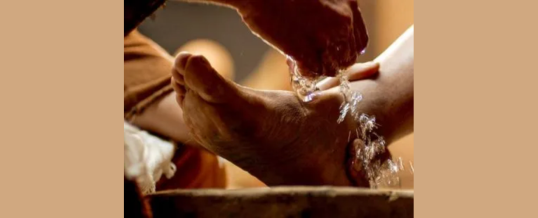
That first reading from the Book of Exodus speaks about the central feast of our Jewish brothers and sisters down to this very day—the great feast of Passover. What I didn’t realize, until recently, is that the entire passage is a monologue spoke by God. It’s God speaking instructions about how to prepare the Passover meal and what to do with the lamb’s blood afterward. It ends with a command to do this ritual, that is, observe Passover as a perpetual ordinance. Doesn’t that sound a whole lot like Jesus’ command to, “Do this in remembrance of me”? It is God alone speaking in this passage from Exodus.
Just as the first reading was a monologue from God’s mouth, similarly, the second reading is a monologue from Jesus’ mouth. It is part of Paul’s letter to the Corinthians. Jesus tells his disciple to eat this bread as it is his body. They are to drink the wine as well; the wine is his blood. It is the new interpretation of the original Passover celebrated 1,300 years prior. Jesus is the new and eternal lamb, sacrificed once and for all. His blood is to mark the doorposts of our hearts and the hearts of all who drink it.
God’s words in the first reading as well as Jesus’ words in the second, as important as they are, give way to something more powerful than words in the gospel—action. Jesus says very little during the supper, but his actions speak volumes about who he is, about who his Father is, and about why he came to us in the first place.
It says, “Having loved his own who were in the world, he loved them to the end.” We can do a lot with these words “to the end” can’t we. I would like to look at it this way, which isn’t the only way of looking at it. That second reading, Paul’s letter to the Corinthians, speaks about the Last Supper. It comes from the 11th chapter. Just two chapters later, Paul writes something you are all familiar with. We traditionally call it the “Hymn to Love.” You know the words—”Love is patient, love is kind, never rude or boastful,” etc. It ends with, “When everything falls apart, fades, dies and is no more, only three things will remain until the end—faith, hope and love. And the greatest of these is love.”
Today’s gospel says that, “Jesus loved his own who were in the world, and he loved them to the end.” I think it’s a hint about where everything is going, especially the next day on the Cross. When everything falls apart, fades and dies, as it will for Jesus on the Cross, what will remain is the greatest of all—his love for us.
Knowing that love can never die, Jesus gets up from the table and takes off his outer robe. He will wash his disciples’ feet, put his robe back on, and return to the table.
I often wondered why the evangelist John, when telling us this story, felt compelled to include such mundane details as Jesus taking off and putting on his outer robe. Again, it’s a rich symbol with many legitimate interpretations. One interpretation could be this. In the Greek, the language of the gospels, to “take off” is the same verb as to “lay down.” Earlier in this same gospel, Jesus says, “No one takes my life from me. Under my own power, I choose to lay it down, and I choose to take it up again” (Jn. 10:18). By taking off his outer robe, he is telling us that he is making a conscious choice to lay down his life for us. Before the Roman soldiers could take his life, Jesus had already laid it down. The disciples then probably didn’t get the symbolism of the taking off of the outer garment any more than we get it now. But even if we don’t get this gesture of Jesus he, nevertheless, asks us not to resist him. It’s as if he’s saying to us as he once said to Peter, “I know you don’t get it, but just let me do it—just let me take off my outer garment for you; just let me wash your feet. Just let me do it. It’s my way of loving you. It’s my way of laying down my life for you.”
The other half of the story is that after he finishes washing his disciples’ feet, he puts the outer garment back on. Once again, in the Greek, “to put on his robe” is the same verb used as when Jesus says, “I have the power to take up my life again.” Taking off his outer garment and putting on his outer garment are both conscious choices on Jesus’ part. Laying down his life and taking up his life are both conscious choices on Jesus’ part. You and I are his choice tonight. He consciously chooses us even if we don’t get it or don’t feel worthy of it.
When I let my imagination go a little wild with this reading, I imagine Jesus not making eye contact with his disciples during the foot washing. Now he probably did the exact opposite; he probably looked each of them directly in the eye with a love beyond words. The reason I think Jesus may not have looked them in the eye, except for Peter, perhaps is for this reason. By looking at their feet, and not at their faces, it’s highly unlikely Jesus would have been able to distinguish one disciples’ feet from another. It’s doubtful that he would have distinguished the feet of John, the Beloved, from the feet of Judas, the Betrayer. Not knowing whose feet were whose, he would have shown each of them the same love, affection, and tenderness. Apparently, God causes the sun to rise on the good as well as the bad and sends rain to fall on the crops of the upright and the wicked.
As we come forward to have our feet washed and as we wash the feet of others, let’s have that same mind that was in the mind of Christ. There are no distinctions when it comes to washing feet or eating bread or drinking wine. There are no worthy feet or unworthy feet. There are no rich feet or poor feet. There are no Jewish feet or Palestinian feet. There are no conservative feet or liberal feet. There are only feet that are trying to find their way to God just like your feet are.
When everything else falls apart, fades, and dies, only faith, hope, and love will remain. And the greatest of these is love.
~Fr. Phil
APR
2026
About the Author: