
In that Passion account we just heard, within just a few hours, Pontius Pilate asked Jesus 11 questions. Nobody in the entire Bible (Old Testament or New Testament) asks as many questions as he does. It becomes clear that Pilate really doesn’t want to know the answer to any of these questions. When Jesus, who is the Way, the Truth, and the Life, says that he came into this world to testify to the truth, Pilate asks him a question, “What is truth?” Pilate is not interested in the answer, nor is he interested in growing in the truth. “What is truth?” is not a question, even though it’s followed by a question mark. Pilate is simply being sarcastic and insulting. It’s meant to be read that way, “What is truth?” For Pilate, truth is a joke, and Jesus is wasting his time.
Pilate sees no power or value in pursuing the truth, in living an honest life. The real power for Pilate has got nothing to do with truth and everything to do with money, corrupt politics, influence, fame, notoriety, and the ability to get people to submit to your will. Pilate keeps asking Jesus questions hoping to whittle down the Truth into his own, delusional version of the truth, which in the end is no truth at all. Much like President Trump, Pilate was similarly enamoured by his own self-importance and power. Unfortunately, it is a power that is disconnected from love and so becomes self-serving and destructive to others.
Of the 11 questions that Pilate asks, here’s the one that I think shows how far Pilate has drifted from any sense of reality. Frustrated that Jesus will not get into his small world, Pilate ask, “Do you not know that I have the power to release you, and the power to crucify you?” Don’t you know that I have power over life and death? Don’t you understand the gravity of the situation you’re in? Don’t you understand that your life is in my hands? Or as Trump said to Ukrainian President Zelensky, “Don’t you know I hold all the cards?” Jesus’ answer to Pilate is what seals the deal and sends him to his crucifixion. Jesus reminds Pilate that he has no power of his own but that it was given to him from God above. This is a crushing blow to Pilate’s ego. And maybe, just maybe, Jesus wants to deliver that same message to us.
So many of us live deluding ourselves into thinking that we have power. Power over ourselves. Power over our spouse or children. Power at work. Power in the parish and in the neighbourhood. But if there is anything to learn from Pilate’s many questions, it might be this: That you and I don’t have any real power.
We are as powerless as Pontius Pilate, and we hate it as much as he did. We prefer to pretend. We walk into Church on Good Friday imagining ourselves as powerful. And we’ll walk out probably thinking the same way.
It isn’t until someone we love gets cancer. Or until someone we love loses their job. Or it isn’t until someone we love loses their battle with alcohol, drugs, or gambling. Or until we turn on the television and look into the faces of victims of war, violence, or natural disasters. Or until we meet someone who will live with and die from a chronic illness from which there is no remedy.
It isn’t until that moment that our delusional thinking gets the Good Friday “reality check.”
We follow a Jesus who surrenders to all the pseudo-powers of the world. This all-powerful Saviour let’s others beat him, whip him, spit on him, tell lies about him, mock him and crucify him. He lets the world have its way with him. But more importantly he lets his all-powerful Father have his way. When you see who Jesus is really surrendering his power to (God and not Pilate) you will walk out of here today a little bit changed from when you came in.
God is more powerful than Roman procurators, more powerful than presidents and kings, more powerful than cancer, more powerful than addictions. God is more powerful than human progress, human pride, and human sin and weakness.
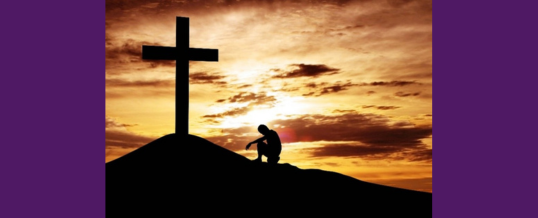
Today is the day to set aside our delusions and admit, before the Cross, that we have no power. When Jesus did it, he was nailed to a cross. And maybe that’s why we are so terrified of surrender, of facing our own truth. We fear the very thing that sets us free.
Pilate’s infamous question (which I told you really isn’t a question at all), “What is Truth?” is not answered with words. It’s answered with a wordless surrender. Maybe we resist surrender because we know where it leads. Today’s gospel ended with the simple words “the tomb was nearby.”
You and I have to let the tomb be nearby. Close to our hearts. Close to our minds and souls. The closer we are to the tomb, the closer we’ll be to the Resurrection. We have to remember that we can’t rise from the tomb unless we first enter it. Let’s enter whatever tomb is nearby. Let’s do it without fear. Everything that speaks of death has already been emptied from the tomb once and for all
As you come to venerate the Cross, let it be an act of both surrender and gratitude. The only real power worth having comes from the wood of that Cross.
~Fr. Phil
APR
2026
About the Author: