
When it comes to good storytelling, usually the storyteller tells the story and then gives the meaning only afterwards. In between we’re supposed to try and see how the story connects with our lives. But like last Sunday’s gospel, Luke again breaks storytelling rules by giving us the meaning and then tells us the story. The opening line says that Jesus told this parable to some who trusted in themselves that they were righteous and regarded others with contempt. So, now we know that it’s going to be a parable about people who are full of themselves and who look down on others. Another way of telling the parable about the bragging Pharisees and the humble tax collector, might go this way.
Jimmy, the local drunk, womanizer, and thief dies. His wife, a proper lady, wants a nice funeral for him to keep up appearances, if for nothing else. So, even though religion meant nothing to Jimmy, his wife, nevertheless, goes to visit the parish priest. “Please,” she begs the priest, “I know Jimmy was a scoundrel and never went to church, but can’t you at least bury him and say a kind word over his body?” The priest looked up at the poor, pleading woman and felt sorry for her. “Oh, all right,” the priest said. “Bring him to the church tomorrow, and I’ll see what I can do.”
The entire town and every one of Jimmy’s relatives, down to his third cousins, turned up at the funeral to hear what good a priest could possibly think to say about a guy like this. The priest took a deep breath, looked over the straining, expectant crowd, thought a moment, and said, “I know Jimmy O’Brien was a drunk, a womanizer, and a thief. But next to the rest of his family, this guy was a saint!”
We all have an ego. When the ego is connected to the True Self (the True Self being who we are in God), the ego remains healthy. The late Mother Teresa had a healthy ego. She had an ego but was anything but egotistical. She could stand in a stadium, and simply say, “God loves you,” and 60,000 people would go nuts. (I could say exactly the same words and three-quarters of the people at Mass would yawn in unison). So, there is such a thing as a healthy ego; it’s the one connected to the True Self. However, when the ego is disconnected from the True Self, and takes on a life of its own, it becomes unhealthy, “egotistical.” An unhealthy ego is self-referential or the “churchy” word for that is self-righteous. It stands on its own and wants to be acknowledged, praised, and offered incense 24/7. It’s so fragile and needy that it needs the attention of others all the time to bolster it up. Donald Trump would be a classic example of this. Sometimes we need to see the exaggerated version in others in order to admit that it’s in each one of us, also. The unhealthy ego is self-referential, that is, it uses itself as the standard for everything it believes is good in the world. It stands on its own and falsely believes it needs neither God nor anyone else. Yet, the irony is that the unhealthy ego is continually seeking the praise of God and everyone else.
We are told, in the parable, that the Pharisee was standing by himself. The unhealthy ego has to separate itself from anyone else, because it can’t stand blending in with the crowd. It can’t stand someone else getting noticed and getting credit for something. The Pharisee’s prayer starts off not bad, “God, I thank you…” and then it goes down hill quickly after that. The imperial ego, which is one inch under the surface in all of us, quickly takes over. Although the Pharisee may be addressing God, he is really talking to himself. The pronoun “I” is repeated four times: “I thank you that I am not like other people. I fast twice a week. I give one-tenth of my income.” He is the center of his own prayer.
The Pharisee has enter the world of comparison, and worst than that, the world of superiority. For the Pharisee the real action is between him and the lowly tax collector. God, the focus of all genuine prayer, has receded completely into the background. The unhinged ego of the Pharisee cannot believe in its inherent goodness, a goodness given by God, a goodness that does not come from fasting and tithing as wonderful as those things might be.
The tax collector is a study in contrast. Whatever the Pharisee is, he is not. He doesn’t stand by himself at the center of the Temple but quietly at a distance where nobody has a chance of noticing him. He prays an honest prayer. He’s not dressing himself up to look better than he is; he’s dressing himself down to remain in touch with who he really is. He knows he is a child of God, who is far from perfect, and he is fine with the that. So, he prays from that honest place within himself. His pray is the one accepted by God, and he’s the one who goes home justified, not the Pharisee.
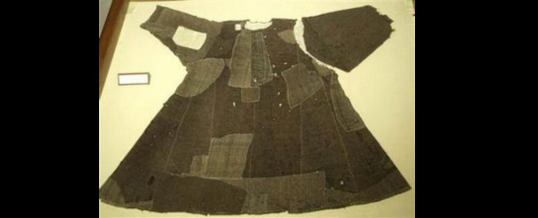
The tax collector reminds me of St. Francis of Assisi. A number of years ago, while at the Basilica of St. Francis, in Assisi, I wandered away from the group I was on pilgrimage with. I entered a room that I didn’t know was off limits. Seeing as I was the only person in this room, it should have triggered in me that something wasn’t right. In front of me, under a class container was the one and only garment St. Francis wore after his conversion. It was a tunic with patches all over it. The irony is that Francis’ father was a rich merchant who made his living selling fine clothing and velvet, a luxury of the time. Francis wanted people to see on the outside what he was on the inside—patched, broken, poor, needy of God’s mercy.
When we allow our ego to be defined by our True Self, the only Self God can and does love, we have no more need to dress ourselves up with fancy clothes, prayers, titles, or accolades. The True Self is completely at home in God and knows it’s not superior over anyone else. Once you know that, there is no more need to compare yourself to anyone else. The you that God created is more than enough. Once in touch with this inside yourself, you begin to see it in everyone else. You see everyone as your brother and sister regardless of their status in society.
The rabbi addressed his students with the question, “When can you tell the night has ended and the day has begun?” One of the rabbi’s students offered the reply: “When you can see a tree in the distance and tell if it is an apple tree or a pear tree.” The rabbi answered, “No.” Another student responded: “When you can see an animal in the distance and can tell if it is a sheep or a dog.” Again, the rabbi said, “No.”
“Well,” his students protested, “When can you tell, that the night has ended, and the day has begun? ”And the rabbi responded, “When you can look on the face of any man or woman and see that he is your brother, that she is your sister—because if you cannot, no matter what time of the day it is, it is still night!”
The Pharisee who thought he did it all right, according to the Law, remained in the dark. The tax collector, who seemingly did it all wrong, knew that the night had ended, the day had begun, and went down to his home justified in the eyes of God.
~Fr. Phil
OCT
2025
About the Author: