
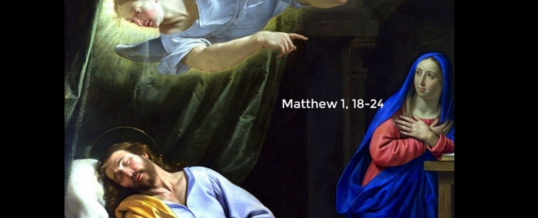
Once again, the readings the Church asigned us have a common thread between the first reading and the gospel reading. Each is about a man who finds himself in a dilemma. King Ahaz, in that first reading, deals with the dilemna poorly while Joseph, in the gospel, handles his predicament much better. Let’s look at these two contrasting guys and see what God might be saying to us .
Firstly, let’s look at King Ahaz who was the king of Judah. The Jewish people were living between two sister countries, Israel in the north and Judah in the south. Even though they all belonged to God’s Chosen People—they’re all Jews– these two siblings countries didn’t always get along. King Ahaz in the southern kingdom of Judah is far from being the good king his father once was. Ahaz has not only turned his back on his father’s wisdom but also turned his back on God. He has allowed all kinds of paganism, all kinds of idol worship, to enter Judah. His own narcissism has blinded him to peoples’ needs and caused him to be selfish and totally self-serving–the Donald Trump of the Old Testament.
King Ahaz didn’t like when the king of Israel scolded him for turning his back on God. Ahaz didn’t like to be corrected even by fellow Jews. So, he put his hope in a military alliance with an enemy country, Assyria, and continued to worship false gods. The prophet Isaiah told King Ahaz that only God can be trusted, only God is our security, not military might. If he would just turn back to God, God would grant him anything his heart desires. Isaiah said, “Ask for a sign, Ahaz, any sign at all, and God will prove He’s there for you. If you want an earthquake, ask for an earthquake. God really is present and powerful. Ask for a lightning bolt from the sky if you want. Ask for a sign if you don’t believe that God can transform your world. God will prove himself to you.”
Ahaz’s response is, “I will not ask, and I will not put the Lord to the test.” This is a sign of false piety. God wants us to ask. God is just waiting for us to ask. God delights in us coming to Him with our struggles and would never turn us away. Jesus, who is in perfect union with the mind of God, will tell his followers, “Ask, ask, ask, and it will be given to you. Seek, seek, seek, and God will not play hide-n-seek but will make it so easy for you to find what you’re looking for. Knock, knock, knock, and God will swing the door wide open for you.” Ahaz’s personal life, his kingship, and his country are all in a mess. But, King Ahaz will not ask. It’s not reverence for God that holds him back. It’s his unwillingness to risk giving up control that keeps him from standing before the Lord and admitting he needs God.
He’s the king, and he feels he needs nobody. Everything is clearly a mess, but at least he’s in charge of the mess, so he tells himself. Fear has paralyzed him. He’s afraid to move, afraid to grow, afraid to change. The prophet Isaiah dares King Ahaz to go out on a limb. But something in Ahaz and something in all of us is afraid to expose ourselves to God. If we open ourselves to God in prayer, we might have to change, to give up something. Genuine prayer is risky. It requires a certain flexibility, readiness for a sign, readiness for an invitation to grow and change, perhaps even change deeply. So, we play it safe and don’t ask.
We have all had an experience of a person who suffers from some kind of addiction or somebody who is really messed up and absolutely refuses to talk about it or to seek help, to see a doctor or a counsellor because they are afraid. If they take any kind of a step, they may have to change—and there’s a certain security in the control they falsely think they have. They’ll consider reaching out or praying someday, but just not today. On some level, we are all control freaks like King Ahaz. We’ll push it off as piety or “not wanting to bother God, since God is so busy with more important world events” rather than opening ourselves to God’s life-giving will. At that point, control and fear are stronger than love.
Here comes the contrast in the gospel story of Joseph. Like King Ahaz, Joseph too feels he’s between a rock and a hard place. He is betrothed to Mary. A betrothal is more than an engagement as we know it. This is the Mediterranean culture, and a betrothal was a type of pre-arranged marriage, an agreement between the families of the bride and groom. These betrothals were not so much for the union of the man and woman but for the union of the extended families. Keeping the clan together was of ultimate importance. Although girls could get married as young as 12, the betrothed couple didn’t live together until the the girl was at least 14. However, a formal divorce was still required to break the betrothal. That was Joseph and Mary’s situation—married in the eyes of the Law, but not yet living together.
Joseph finds out that Mary is pregnant, but he knows he’s not the father. He still doesn’t know who the real father is. Under the Law, the man had a right to return the young woman, Mary in this case, to her father and even expose her to death. If Joseph doesn’t act quickly, both Mary and he will be shamed publicly. Joseph is an honourable man, a good man, a righteous man we are told. Even before he knew the truth from the Angel of the Lord, about how Mary became pregnant, he was determined not to hurt Mary even at the risk of his own standing in the community. He planned to dismiss her quietly and not bring any more pain into Mary’s life.
Joseph is a man who speaks to our own time. He knew stress and anxiety. He must have known economic uncertainty wondering if he could support and sustain a family running a small business. He had to pay taxes, to “render unto Caesar” like everyone else. After Jesus was born, Joseph and his family became refugees in a foreign land, where his ancestors toiled as slaves under Pharoah. Joseph lived with the threat of terror running from a ruthless king bent on murdering children. On a personal level, Joseph, like all first-time fathers must have asked himself: Am I ready to be a father? Am I good enough, strong enough, wise enough? Then confronting the real possibility of scandal, Joseph must has had more than a few restless nights. He must have wondered whether he could protect and spare the woman he loved. And like Mary herself, he must have thought at some point: This is not what I planned.
Like so many of us, Joseph must have been overwhelmed with confusion, doubt, anxiety, and fear. What do I do? How do I get out of this?
In the midst of Joseph’s complicated life, comes a voice in a dream, “Do not be afraid. God is with us.” In that instance, his world and our world changed. God sees beyond our fears, beyond our limitations. Joseph’s dilemma no longer seemed impossible to overcome. When our lives seem like a nightmare, we cannot forget to dream. When demons make our lives hell, we cannot forget to listen for angels. When our lives have been turned upside down, we cannot forget to trust that God will make it right. When anxiety overwhelms us, we cannot forget the words from on high, “Do not be afraid.”
Ahaz could not trust in a power greater than his own limited, kingly power. He held tight to his own self-importance and could not turn to God for help. Joseph, by contrast, submits to the messenger of God, believes in God’s plan for himself and his family. Joseph, is the man who helps us in this final stretch to Christmas. He doesn’t utter a word in the gospels but his ability to trust, to dream, and to listen speaks volumes.
King Ahaz didn’t ask for a sign, but God gave it to him anyways. It’s the sign of a young woman with child. Nothing is more intimate than a mother and child. It’s the same intimacy God desires with each of us.
~Fr. Phil
JAN
2026
About the Author: