
For well over a thousand years before Jesus was born in Bethlehem, prophets—special envoys of God—were sent to remind people that God had not abandoned them. In fact, they were to wait for the Messiah, whose desire it was to be close to people and to bring them salvation. Most of the people, because they did not see the Messiah in their own lifetime, just gave up waiting. But a small group of people didn’t give up at all. They remained faithful to God’s promise. They are called the “faithful remnant.”
When I think of a remnant, I think of carpet. When the large piece of carpet has been cut to size to fit the room, the leftover is called a remnant. Similarly, those who stayed close to the promise of God, the promise of the forthcoming Messiah, were a remnant, a small portion of the Jewish people and not the majority.
Mary, Joseph, Elizabeth, Zechariah, John the Baptist, the old couple in the temple—Simeon and Anna—are part of the faithful remnant. They never gave up on God. They stayed hungry and thirsty for God in their lives and were rewarded for their patience.
A few years back, you may recall this beer commercial that ran on T.V. It featured a bearded, debonair, older gentleman who was described as “the most interesting man in the world.” The commercial was very effective, and the sale of this Mexican beer, Dos Equis, multiplied not just in Mexico but everywhere. The commercial ends with this well-dressed, well-groomed man saying, “I don’t always drink beer, but when I do, I drink Dos Equis (Spanish for “two Xs). Stay thirsty, my friends.” Now, I know the point of the commercial is the point of all commercials—to sell more product. But it makes a good point. Stay thirsty. And since it’s Christmas, I would add, “stay hungry.” The faithful remnant, the ones who never give up on God and God’s promises to transform the world, are the ones who stay hungry and thirsty.
We are very fortunate, those of us who know English and even a little bit of French. The English word for a food trough, where barn animals eat out of, is called a manger. It is spelled exactly the same way as the verb “manger” in French which means “to eat.”
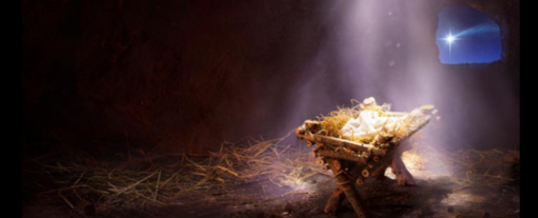
The story of Jesus’ earthly existence starts with Jesus being born and immediately laid in a manger. Before Jesus is able to speak, the gospel writer, Luke, is telling us that Jesus is food for the world. That’s why he came into the world. That’s his purpose—to feed you, me, and the world. That’s why he’s in the manger. That’s how the Jesus story starts.
At the end of the gospel, Jesus sits down with his Apostles at what we traditionally call the “Last Supper” and he say, “Take and eat, this is my body given up for you.” So, he’s food at the beginning, he’s food at the end, and he’s food at every moment in between. There isn’t a moment where Jesus doesn’t pull up a chair at the table of your joys and sufferings and say, “I’m here, I know what you’re going through, come and eat of me.” All he wants from us is that we show up hungry. All we have to do is show up at the banquet table with our appetites. That should be the criteria for anyone who shows up at our church doors or the doors of our homes.
Are you hungry?
Yes.
Good. Come on in. There’s a seat around our table for you.
But what about my sketchy, sinful past?
Are you hungry right now, regardless of your past?
Yes.
Well then, come in a eat.
Ya, but if you knew my inner thoughts and the judgments I make about people, I’m sure you would not want me.
Are you hungry?
Yes.
Well, come on in. Eat first, and we’ll deal with your judgments another time. Now is the time to eat.
But, I don’t go to Church, it’s been years since I went to confession, and I was told that if I’m not in a state of grace, I shouldn’t come to the Table.
Are you hungry, now?
Yes, that’s why I’m here.
Then come in. All those who are in a state of grace or disgrace are welcome, for the Son of God came to seek out and find the lost. Don’t you know, I’ve been going to the highways and byways looking for you. I want you at my banquet. You’ve been on my guest list forever. All I want to do is feed you. All I want is to give my life to you, for you to take me in—through your mouth and not your head—so that you can grow strong on me.
Fr. Richard Rohr, who I love to quote, had a friend who was in the process of writing a book and wanted Richard to read the manuscript and give him some constructive feedback. It was a book on spirituality. This man had seen the movie Rocky III (I think there’s been six Rocky movies). In Rocky III , if you remember, Rocky has at this point become more or less a complacent, high-living champion. And his manager says to him, “When a boxer becomes civilized, that spells the end of his boxing career.” Rocky’s former foe comes in and tells him, “You’ve lost the eye of the tiger.”
Have you ever looked into a tiger’s eye? What immediately grips you, is that the tiger is right there, all 450 lbs. focused with a gleaming, maximum attention on you. No distractions, no hesitations, just a calm, powerful contemplation of you. He says Rocky no longer has the eye of the tiger. He’s no longer “hungry” for victory. He’s got no dreams left. There’s no need left in his eyes, no hungry need.
The only way an athlete can keep his edge and stay focused like the tiger, is if he stays hungry. So, his manager takes him away from the three-ringed circus of the gym where he’s only half training in between signing autographs and posing for pictures. The manager brings him down to a back alley gym filled with youthful contenders. And as Rocky looks around and searches their eyes, he could see that every one of them had the eye of the tiger that he had lost. They were still hungry for what was still possible to wring out of their otherwise empty lives.
Then, this author makes, interestingly enough in this book, a comparison with Jesus. He says Jesus began his public career with 40 days in the desert deciding who to call as his Apostles. His criteria wasn’t, “Who has the greatest talent?” Or “social grace?” Or, “Who is the most morally upright?” There’s no evidence of that. He says, “I believe he looked into the eyes of the men he had met and chose, and he looked for those who had the eye of the tiger. He looked for those who were hungry for life, who wanted something more, who were willing to drop everything for the great adventure. So, he passed by the scholars. He ignored the rabbis. He dismissed the socially prominent. And, he chose from a hungrier class.” He says, “that’s why most revolutions come from the bottom, not the top…where you gotta be hungry. Rough, illiterate, one at least we would call now a ‘terrorist,’ perhaps criminals, the immoral minority, the black market people, the local Mafioso. They (Apostles) could have been anything at all as long as they had that look, as long as they had ‘need’ written all over their faces.”
Maybe that’s a clue as to why the lowly shepherds, who were despised and not trusted by society, make it to the manger before the Wise Men do. They were just hungrier than anyone else. When you have everything you need in life, you tend not to hungry for anything or anyone—including God. The only group of people Jesus had any trouble with at all were the Pharisees. They lived in their own bubble, their own self-righteousness. They were know-it-alls. When you think you know it all, who needs anyone else? Who needs God? Jesus could do nothing with them.
Stay hungry my, friends. You are part of the faithful remnant who have never given up. Everything you ever hungered for is right there in the manger. This baby Jesus grows up and says, “I thank you, Father, Lord of heaven and earth, for having hidden your ways from the sophisticated and know-it-alls but spelled them out clearly to ordinary people, even to children. Yes, Father, that’s the way you like to work.”
~Fr. Phil
JAN
2026
About the Author: