
Some 60 years ago, when the Second Vatican Council ended (1963-1965), the world’s bishops were looking for a metaphor to describe the Church. They settled on not calling the Church a divinely instituted hierarchy but instead a “pilgrim people of God.” What they were saying was: 1) the Church is made up of people, 2) the people are God’s people, and 3) these people were on a journey, a pilgrimage you might say. Until then we always thought life was one great big journey to God and if you did more good than bad, then the scales would be tipped in your favor when you died, and you would finally have found God. Since then, we realized, the entire Church is on a journey, not just individuals, but God is looking for us much more than we are seriously looking for God. It’s the Shepherd who is looking for the sheep much more than the sheep looking for the Shepherd.
In that second reading, Peter says that we’re on a journey, every one of us, and we must travel it with a consciousness of God. We do not have to spill human blood or animal blood to get to God or to get on God’s good side. God spills blood to get to us. What a turn-a-round in consciousness! God didn’t ransom you with silver or gold but with the blood of Christ. Like, who does this? No one that I know of. Peter goes on to say that “Christ was destined” to do this before the foundation of the world. In other words, Jesus did not come to mop up our sins after everything fell apart (damn Adam and Eve!). No. Before the world began, God desired to come to us out of sheer love for us. God’s desire was always to get close to us, and if his Son has to spill blood in order to bring us into intimacy with God, then that’s the price God is willing to pay. Love, freely given, wants only one thing–to be freely received.
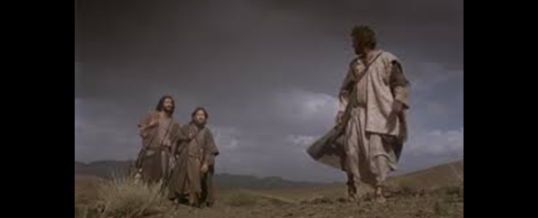
The two disciples on the road to Emmaus, in today’s gospel, are also on a journey. It is Easter Sunday, and two despondent disciples are walking away from Jerusalem. What is Jerusalem? It’s the place of Jesus’ suffering, death, and resurrection. If you walk away from Jerusalem, you are walking away from the true meaning of Jesus’ suffering, death and resurrection. It is also getting darker, we are told, almost evening. This could mean that the sun was setting or that their consciousness was still in need of being enlightened. When the Risen Lord catches up with them, their eyes were kept from recognizing him.
When Jesus asked them a very simple question, “What are you discussing as you walk along?” words just spill out of them. Part of what they say to Jesus, without realizing they are actually speaking to him is, “We were hoping that he was the one to redeem Israel.” Obviously, by their disappointment, Jesus clearly did not live up to their hopes. It’s a terrible thing to live without hope. Or worse than that to put all your hope in one person only to have to have that person fail you. How devastating it must be to have a marriage fail, a promising career crash and burn, a close friend betray you, or to receive a terminal diagnosis. This is not the way I planned for things to unfold and, yet they did.
These two people on the road are devastated by the cards life has just dealt them. They hold onto a glimmer of hope even though their plans are thrown out the window. By saying, “We hoped he would be the One to redeem Israel” they are echoing the hopes of the Jewish people for centuries. They knew and loved Jesus the Messiah, but for them he was a messianic prophet, like Moses, mighty in deed and word before God and all the people. They banked their hopes in a strong liberator who would do two things: free the land from the Roman domination and punish sinners. That’s what they looked for, but that’s not what they got in this “stranger” walking alongside them.
I compare it to myself when I do grocery shopping. I go into the store with the same boring list of items week after week, month after month, year after year. Why I even bring a list is beyond me. It’s the same stuff in the same aisle over and over again. About 20 years ago, I discovered that grocery stores have an “international” section. This was earth-shattering for me. The international section was small, but because I buy the same boring stuff over and over again, I paid no attention to it. I forgot that it even existed. Lately, I’ve rediscovered the international section which has grown into almost an entire aisle of its own. It was always there, it was always growing, but because I wasn’t looking for it, I totally missed it. I’m beginning to appreciate why the disciples didn’t recognize Jesus walking with them. You find only what you are looking for.
The disciples on the road to Emmaus were looking for a warrior God who was hell-bent on punishing sinners. That’s what they were hoping for. That’s what they trained their eyes to look for. Jesus–before, during, and after his resurrection—came to tell us the new story of God. The old story, that was kept alive by people hoping for a conquering Messiah, was now being replaced by a new story of a suffering and dying Messiah who actually “wins by losing.” When Jesus enlightened the minds of the disciples by explaining the Scriptures to them, this new story just didn’t fit for them. Instead of a Messiah who conquered enemies, Jesus was a Messiah killed by enemies. Instead of talking about “wiping out an entire civilization,” Jesus forgives his enemies by saying, “Father, forgive them for they do not know what they do.” Jesus is a Messiah who conquers by compassionate love and subdues enemies by reconciliation and forgiveness—this is the new Easter story that Jesus tells us.
So, how do we get in touch with the true Messiah, the Risen One in our midst, instead of just repeating the old story? You simply do as the disciples did towards the end of today’s gospel story. Letting go of all their pretense they merely said, “Stay with us.” And he stays with them. That’s it. A simple invitation. Jesus pretends to walk ahead, but they urged him strongly, “Stay with us.” And the reason is interesting, “because it’s almost evening and the day is nearly over.” It’s a hint that Jesus is going to do that famous evening meal, once again, the one we call the Last Supper. Or it could mean, “we’re still in the dark, the world is in darkness, and we need your abiding presence. We need you to stay with us.”
I hope the children who are coming to the Eucharistic table for the first time and those of us who have been coming for years will come to know that all God needs from us is a simple invitation to “stay with us” and God is right there.
Even though it was misaligned, the disciples on the road to Emmaus retained hope. It was only a flicker, but by a simple invitation to “stay with us” Jesus was able to blow it into a flame. Their hearts were burning within them and so can ours. Like them was also live with hope. This hope is based on the truth of Jesus’ suffering, death, and resurrection and is what keeps us journeying on.
~Fr. Phil
APR
2026
About the Author: