
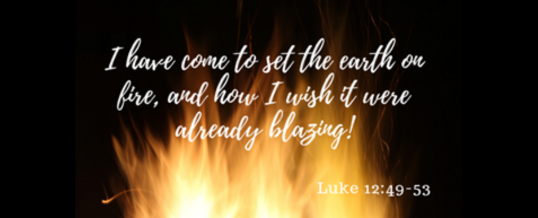
Jesus said, “I came to bring fire to the earth and how I wish it were already kindled.” We better not tell that to the people of Miramichi or Irishtown or the many other places in our country alone threatened by wildfires that this is Jesus’ intention. Jesus continues with equally contentious and provocative words when he said, “Do you think that I have come to bring peace to the earth? No, I tell you, but rather division!”
What are we to make of these statements about fire and division? What might have been Jesus’ message to those people then and to us now?
Let’s start with this “fire” that Jesus wants to bring to the earth. These words of Jesus are not measured or carefully weighed that demonstrates Jesus’ well-thought out game plan for the world. This is an impassioned outburst, the eruption of Jesus’ heart that reveals what drives him. He’s a man on a mission and is impatient for it to be accomplished. The fire that he wants to cast on the earth is the very fire inside of him propelling him forward. I believe it is nothing less than the Holy Spirit alive in him and wanting to be unleashed on the world. I hope you have met at least one person in your lifetime whose passion never subsided even though they were well into their senior years.
The Prophet Jeremiah, who we heard from in that first reading, once said, “There’s a fire burning in my bones. I’m worn out trying to hold it in” (Jer. 20:9). Again, I hope you have met someone whose vocation was so compelling that they say stuff like, “I cannot not do what I’m do, even if try. I have to do this.” That’s fire. Jeremiah wished he could hold it in but realized at some point he couldn’t. He could not “not” speak God’s word.
During the time of the Prophet Jeremiah, the king’s officials rendered the king powerless and convinced the king to get rid of the Prophet Jeremiah. King Zedekiah said, “The king is powerless against you, do as you wish with Jeremiah.” So, they threw the Jeremiah down a well where he sank into the mud. That ought to shut him up. But it didn’t. Unlike Jeremiah who was, at least initially, reluctant to speak God’s word, Jesus isn’t looking for ways to play it safe, to hold the words in. He wants to set the world on fire. Like Jeremiah, Jesus is also impelled by a fire that God placed within him. He will not be thrown down a well, but he will pay the price for his faithfulness to God by being nailed to a tree. Prophetic people, to this day–especially people who carry a message we need to hear but do not want to hear–are still being thrown into mud holes and placed on crosses in order to silence them.
Continuing with fire, John the Baptist said that he baptizes with water, but that the One coming after him—referring to Jesus—will baptize with the Holy Spirit and fire (Lk. 3:16). The despondent disciples on the road to Emmaus encounter the Risen Jesus and afterwards say to each other, “Weren’t our hearts on fire when he spoke to us on the road? (Lk. 24:32). Later on we hear that the Apostles received the Holy Spirit in what appeared to be tongues of fire descending upon them from above (Acts 2:1-4). This suggests that their speech will be the way the fire of the Holy Spirit will spread upon the earth.
Fire seems to be a metaphor for God’s presence much like it was when Moses clearly heard God’s voice come out of the burning bush (Ex. 3:1-6). This fire of God’s presence does the same thing real fire does. It first destroys, then it purifies, and finally it renews. (The best blueberries you will ever eat will come from a field that had a fire the year before). Destruction, purification, and renewal is the great pattern in nature and in our own lives. This is what Jesus wants to bring to people, this is what Jesus feels compelled to bring to people, and this is what we’ll fight him on almost every time. Jesus’ mission is to bring the fire of the Holy Spirit to every corner of the earth. Many will oppose Jesus and his mission much like a father opposes a son or a daughter fights her mother. Jesus himself is willing to pay the price for being loyal to God, to his Father, to the fire within his bones that wants to be shared.
Jesus is human, fully human. He’s not exempt from the natural fears associated with suffering, loss, or even death. He admits as much when he said, “What stress I am under until it is completed!” There is a cost to breathing Spirit into the world. There is a price to be paid for speaking God’s words to people who are indifferent or even hostile to those words. However, Jesus could not “not” release Spirit into the world. His sense of mission, that he had received from the Father, was greater than his fear of suffering and death. Jesus’ primary loyalty was to God. This loyalty ran thicker than blood. It ran thicker than human loyalty. It ran thicker than loyalty to Church or state both of which conspired to put him to death.
Jesus is the Prince of Peace. He has no desire to divide families, one against another. However, the peace he wants to give us is based on truths that are often inconvenient. When we welcome his truth, we unite in peace. When we prefer convenient lies over inconvenient truths, we divide…father against son, mother against daughter. For the most part, we want window dressing. Instead, we get Jesus, the arsonist of the heart.
Come, Holy Spirit, fill the hearts of your faithful, and enkindle in them the fire of your love.
~Fr. Phil
AUG
2025
About the Author: