
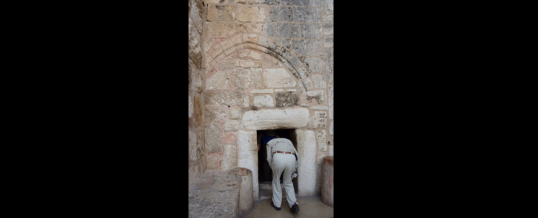
I had the privilege twice of visiting the Church of the Nativity in Bethlehem. This church building is the scholars’ and archeologists’ best guess marking where they suspect Jesus was born. I was a little shocked on my first visit, as I entered Manger’s Square, the outside courtyard leading to the church, that the front door to the church wasn’t obvious. In fact, had the tour guide not pointed out where the door was, I don’t think I would have figured it out on my own. Instead of some grand entrance, the top of the door was no more than four feet high, so you had to duck your head. You also had to lift your feet to step over a one-foot high stone threshold. That gave you about a three-foot opening to squeeze yourself into. But once in, this church opens up into a much larger room with a vaulted ceiling and you heard the voices of the crowd inside speaking, what seemed to be, all the languages of the world. The tour guide explained to us that the doorway into the church wasn’t always that small. Over the years, more of it became walled up so as to keep the enemy out. That’s why it looks more like a fortress than a church.
I think of that doorway when I consider the words of Jesus in today’s gospel, “Strive to enter through the narrow door.” I don’t think he was talking about a physical door at all. What prompted Jesus to say this was that somebody asked the question, “Lord, will only a few be saved?” We’ll never quite know what the motive behind asking this question was. Is it a question about quantity? Will a few be saved? Or will many be saved? Or will everyone be saved? Chances are that it was a Jew asking Jesus, a fellow Jew, this question. Many Jews, at that time, believed that just because they belonged to Israel—that is, that they were God’s chosen people—they would automatically be seated at God’s banquet table. It’s a question of who is “in” and who is “out.” It’s a question of privilege and entitlement. These are the considerations of people at low levels of spiritual development.
Jesus, our spiritual Master, has moved beyond the dualistic world of who’s in and who’s out as well as the world of privilege and power. He turns the question back on each of us. He doesn’t give us the requirement for how to get in to the banquet (say three Hail Mary’s each day for nine weeks and go to weekly confession and you’re in). Instead of canned answers, instead of listing requirements, Jesus is interested in you and the journey you are on. Notice he says, “Strive to enter…” He never once asked us to “succeed,” only to strive. Notice, also, how many self-help books are out there promising us happiness if we can master the formula of succeeding at losing weight, succeed at being financially rich, succeeding at influencing people, succeeding at controlling our emotions, and even succeeding at being more spiritual.
If we are to become the parish grouping I believe we are called to become, or the universal Church God wants us to be, I think we have to take Jesus very seriously when he shifts the focus in today’s Gospel. Maybe we need to take the spotlight off “These are the requirements” and put the spotlight more on, “Where are you coming from?” especially when people are coming to us for the first time or coming back to the Church after a long absence.
Do some of our requirements make it hard for people to feel like they belong in our midst here at church? How many door frames do they have to duck under, and how many thresholds do they have to step over before we say, “You’ve met all our requirements, you can finally take a seat at the Table or have your baby baptized”? Are they more likely to hear, “Fit into the mold, or else. These are the requirements. This is the size and shape of our door! If you can squeeze through it, fine. If not, goodbye and good luck.”
Instead of asking, “Can you meet our requirements?” perhaps we should be asking, “Where are coming from?” I know I haven’t always chosen the better question in my pastoral ministry, especially when it comes to sacraments. It’s a work in progress within myself to become a more welcoming person using Jesus alone as my model. Even the Code of Canon Law, the playbook we are all supposed to be working out of, is far less restrictive and more hospitable than the approach of many Catholic priests. I shouldn’t pass judgment on my fellow priests, but I get annoyed at the way so many of them exercise authority way beyond what the Church itself has laid out in Canon Law. So many hurting people have sat in my office, over the past 28 years, and were told by a church official, “You don’t meet the requirements” instead of hearing, “Where are you coming from?”
When we ask each other, “Where are you coming from?” or “How are you doing?” we are asking a more profound question than we might think. “How are you doing?” means “What’s it like being you? What’s it like in your world right now? What’s it like being a single mom worrying about how you are going to provide for your child? What’s it like living with an abusive spouse? What’s it like being in a dead-end job that gives you no satisfaction? What’s it like being in a marriage that’s lost its spark years ago? What’s it like dragging yourself to school knowing you’re going to being ignored or bullied? What’s it like crying out to God in prayer and feeling like you’re getting no response?”
These people look to the Church not for easy answers but for companions on the journey. Our job is to say, “You may not see a big door welcoming you. Don’t get discouraged. Come around to the side door. You might have to duck and scrunch to get through, but here’s the door most of us entered at one time or another. When you get in, it will open up to a wide space with a vaulted ceiling. Inside you’ll hear the voices of every group of people who walk the earth. In your own language you will hear, “Where are you coming from? How are you doing? Welcome. This is Bethlehem, the place where Jesus was laid in a food trough. Come to the banquet. You thought you were last. Everyone here, from east to west, from north to south, thought the same; they’re all stragglers. This is your place, the place where the last have now become first.”
I’ll end with a prayer that is posted on the doors of St. Basil’s Church in Ottawa. They borrowed it from St. Stephen’s Church in London, England.
God, make the door of this house wide enough
to receive all who need human love and fellowship,
narrow enough to shut out all envy, pride, and strife.
Make its threshold smooth enough
to be no stumbling block to children, nor to straying feet,
but rugged enough to turn back the tempter’s power.
God, make the door of this house the gateway
to Your eternal kingdom.
~Fr. Phil
AUG
2025
About the Author: