
This may be overly simplistic, but I think there are three different ways of approaching and applying the Scriptures to our lives.
The first approach is to look at somebody’s attitude, behavior, or lifestyle and say, point blank to them, “You need to change.” This usually is a stance of superiority over and against someone who we deem as needing to “shape up!” Often times, what we’re saying underneath our breath is, “Your upsetting the status quo in my life. I can’t continue with this good thing that I have going on in my life unless you change.” To put it in churchy terms, “You need conversion.”
A second approach to the Scriptures is to look at myself and say, “I need to change.” This takes me off the superiority pedestal and makes me realize that while I am no worse than anyone else, I’m also no better than anyone else. It compels me to look in the mirror myself, rather than turn the mirror on somebody else, and to honestly ask hard questions like, “Am I becoming the person that God always intended me to be? Do my words, actions, and attitudes build people up or only serve my ego, my agenda?” To put it in churchy terms, “I need conversion.”
A third approach to the Scriptures is to broaden the circle. This third method looks not at your sin, not at my sin, but at what the Church calls “social sin,” or our sin. Collectively, we are the Body of Christ. What we do or fail to do, affects the rest of the Body, the Church, and has consequences for the whole world. To put it in churchy terms, “We need conversion.”
For the next five weeks, starting on September 1st and going to October 4th, the Church invites us to join the 2.5 billion Christians in the world and to celebrate the Season of Creation. September 1st is the World Day of Prayer for Creation or simply called, “Creation Day.” The other bookend to this Season of Creation is October 4th, the feast day of St. Francis of Assisi. Although St. Francis is a Catholic saint, he is honored by Christians and non-Christians worldwide as the patron saint of ecology. St. Francis of Assisi was God’s gift to humanity and was a prophet, way ahead of his time. The late Pope Francis, I believe, was also a prophet. And like all prophets, we usually only appreciate them long after they are gone. Enshrining them in bronze, sculpting them in marble, or creating mausoleums in their honor seems to be much safer than listening to then and changing our hearts while they walk in our midst.
It was 10 years ago, in 2015, that Pope Francis gave the Church and the world the encyclical entitled Laudato Si’; its subtitle is “On Care for Our Common Home”. In it, Pope Francis rightly criticized consumerism, irresponsible economic development as well as lamenting environmental degradation. He wasn’t telling us anything new that science hadn’t already been telling us for years. Pope Francis was getting us, collectively, to consider what our Christian response would be in the face of all of this. In Laudato Si’, he asks us to hear the cry of the earth and the cry of the poor and to formulate a response. It’s an encyclical that describes, honestly, the destruction we are inflicting upon the earth, and its poorest people, but it is also a hope-filled encyclical. We may not have the answer to the mess we’ve gotten ourselves in, but we still have a Christian obligation to respond.
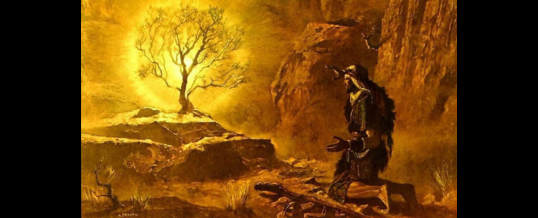
As we begin this Season of Creation, I can’t help but turn to Scripture for guidance. There is the classic Old Testament story of Moses running away from Egypt, but more importantly, running away from God. God appears to him in a bush that is on fire but that is not burning up. God says to Moses, “Take your sandals off, for the ground you are standing on is holy ground.” Do we see this earth and all that it contains as “holy ground”?
The conversation between God and Moses continues with God saying, “Moses, I have heard the cries and suffering of my people back in Egypt. I need you, Moses, to do something in response to the cries of these people, for they are your people, too. You will not have to do it alone, Moses, for I will be with you every step of the way” (Ex. 3). Can we hear God saying to us, “I’ve heard the cry of the earth and the cry of the poor”? Can we also hear God saying to us that He will be with us as we respond to that cry.
Jesus tells us in today’s gospel about the world of humiliation and the world of exaltation. Someone gets humbled while someone else gets lifted up. In North America, and in much of the Western World, we have had the seat of honor at our own self-constructed banquet table. So much so that we just assume it’s our rightful place. Many of the things we take for granted are considered absolute luxuries by much of the people of this world. The most vulnerable of our brothers and sisters are the first to suffer the devastating effects of climate change, deforestation, and pollution. I find it hard to imagine that this is what God had in mind when He entrusted the earth to men and women created in his own image.
When I realized how close the forest fires are to me and how I can even smell the smoke in my own house, it was a wake-up call to the seriousness of what we are doing to this planet of ours. We are being humbled, are we not, just like the gospel portrays. We’ve not invited the poor, the lame, the crippled, the blind, the impoverished people of the world to the one table we’ve feasted from for so long.
Every one of us will be humbled. Perhaps our mental or physical health will fall apart, or our finances will fall apart, or we’ll stand in front of a deteriorating situation that we can’t fix, change, undo, or even understand. Life has a way of taking us from the seat of honor, a seat we thought we would always occupy, to the lowest place. Perhaps climate change, and the warnings of countless prophets, are actually humbling us as we speak. Can we listen to those voices, the cries of the earth and the cry of the poor?
I leave you with an image that I have only recently stumbled onto. I just learned that birds are the only species in the entire world that have two voice boxes (called syrinx). This allows the birds to sing with two voices at the same time from the same mouth. When I learned this, I remembered Pope Francis’ message that the voice of the earth and the voice of her people are not separate but, like the bird, are two notes sung simultaneously of the same song. I can’t imagine a world without the song of birds. Perhaps from their lowly position birds are telling us to move from our place of honor at the wedding banquet. Weddings are about union. Can we move from our privileged places and join the cries of the earth and the poor in their lowly positions? If so, we’ll know we are all on sacred ground. We’ll also know that creation was never meant to be a one-time event. God’s spirit is still blowing across our land recreating and renewing the face of the earth.
It’s more than your conversion and more than my conversion. It’s our conversion.
~Fr. Phil
SEP
2025
About the Author: