
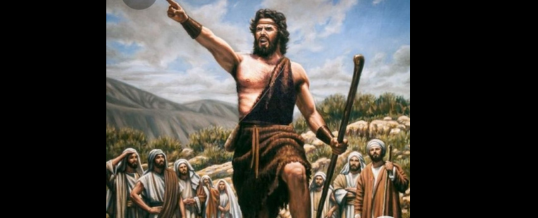
John the Baptist appeared in the wilderness. We are not told how he got there. He just suddenly appears, which automatically moves our minds to mystery. A mystery is about to unfold, and it’s about to unfold in the desert of all places. Cities, like Jerusalem, are where the hustle and bustle of life happens. And just like us, people were going to the desert to escape the rat race that life can often turn into. I think they were also going to the desert, again like us, because they were longing for something beyond the status quo. They were probably asking, “Is this all there is to life? Is this all there is to my faith? Is there a greater meaning I’m not tapping into?”
I think we have all longed for something more than just the daily grind. However, sometimes it’s easier on the psyche to settle for the status quo and just keep thinking the same thoughts we’ve always thought and doing the same things we’ve always done, even if it means running the risk of becoming cynical. Yet, our souls still long for something more and don’t want to settle for cynicism.
In Jerusalem there was a watertight system put in place, by the religious leaders of the time, for getting you into the Temple, for getting your sins forgiven, for getting worthy before God, and for declaring who’s in and who’s out. If you presented yourself, especially at the great feast of Passover, with a less-than-perfect offering—let’s say a blemished lamb–not only was your offering to God rejected—the lamb—but you were seen as not being acceptable to God either.
Religion became a business, and the bottom line of any business is to keep the status quo going especially if it’s making money. In that system God is bought and sold more than loved, waited for, or surrendered to. Jesus’ one clear act of anger was aimed at those selling and buying in the Temple. Underneath the buying and selling, people were tired of this kind of religion, which wasn’t really religion, anyways, but more religiosity. It had the outer trappings of religion but little else. The Pharisees committed their lives to upholding a system that makes God quite inaccessible unless you jump through all the proper hoops. And, of course, they were the ones who set up the hoops in the first place. It was fire insurance for the next world instead of being a love affair with God in this world.
Now we have this joker, John the Baptist, appearing out of nowhere. He has deliberately distanced himself far from the shenanigans of the slick religion of the Temple. He’s telling people God is as available as Jordan River water. And, of course, the irony is that water is in the desert where water is not supposed to be. Likewise, God was not supposed to be found in the desert, only in the Temple in Jerusalem. But this is what people were hungering for then as people are hungering for now—the truth that God can be found everywhere, even outside of institutions, official priesthood or formal observance.
Even though John the Baptist was speaking to them, it was like they were hearing the voice of the Prophet Isaiah who said, “Come, just as you are. Come to the Lord you who have no money. You who are thirsty, come to the water. Don’t spend your money on that which does not satisfy” (Is. 55:1).
Of all the groups of people gathered at the Jordan River, there were two groups that weren’t too happy with John the Baptist. They were the Pharisees and Sadducees. They perceive John the Baptist, and later Jesus, as undercutting their business; they’re losing a commission down at the Temple and they’re not too happy about it. The Pharisees are only interested in looking good without actually being good. John the Baptist, like Jesus, is not too interested in veneer, that is, looking good on the outside. John is concerned about what’s happening on the inside.
The Pharisees want the outside ritual of baptism, but their hearts will remain untouched. John knows they are not serious about repentance and calls them a brood of vipers. Although they say nothing, John knows what’s inside of them. “Don’t presume to say to yourselves, ‘We have Abraham as our father’; for I tell you, God is able from these stone to raise up children to Abraham.” Claiming physical descent from Abraham, without bearing fruit worthy of repentance, means nothing to God. Jesus says the same thing when he tells us how unimpressed he is with people who say, “Lord, Lord” but never lift a finger to help someone in need. I was once told, and constantly need to remind myself, “It’s easy to be a Catholic, but hard to be a Christian.” God can raise up Catholics from the stones in the church parking lot.
There was a Jesuit priest named Raimon Panikkar who died about 15 years ago. He was not only brilliant but also a strong proponent of interfaith dialogue. He might have gotten this second nature having a father who was Hindu and a mother who was Roman Catholic. He wrote in an essay that official religion is increasingly lagging behind people’s actual practice of faith. For people today, he notes, are bringing God back into the world as faith migrates from the “the temple to the streets, from institutional obedience to the “initiative of conscience.” Ignoring the doctrinal disputes between the churches and the world, most people see the pressing problems of faith to be “hunger, injustice, the exploitation of people and the earth, intolerance, totalitarian movements, war, the denial of human rights, colonialism and neo-colonialism.” We might say that people are listening more to the voices calling out in the desert than the status quo coming from Jerusalem or Rome.
Fr. Raimon Panikkar died in 2010, but what he names is what I think John the Baptist was naming 2000 years ago in the desert. They are both getting us to repent and turn our minds and hearts to what is really important and to act accordingly.
We all know change is necessary, but are we willing to change in the ways God wants us to change?
Descendents of Abraham are a dime a dozen. What counts is your life. Is it green and alive? Because if it’s deadwood, it goes into the fire. Everything good and true Jesus will bring alive.
~Fr. Phil
DEC
2025
About the Author: