
All three readings, proclaimed worldwide by the Church today, remind me of the saying, “the seed never sees it’s flower.” If we take it literally, the seed is underground, so it naturally can’t see the blossom above ground. But more to the point, the seed (unless it is a bulb) must die long before the plant ever produces a shoot, a stem, or a flower. The metaphor is true for humans as well. Some of our greatest efforts will only bear fruit after we’re gone from this earth, maybe in grandchildren yet to be born. It’s a call in all three readings to wait patiently, to stay committed, and not to lose heart.
Isaiah, in that first reading, was living and prophesying at a time when his country, Israel, was invaded and destroyed by the Assyrians. Although they fled for their lives, he told them to be patience and stay the course. “Be strong, do not fear! Here is your God” he reminded them. You’re like a dry land now, but someday God will bring you home to the majesty of Carmel and Sharon. Carmel and Sharon were some of the richest and most fertile lands in all of Israel. So, be patient and God will turn the desert of your life into fertile land. Sorrow and sighing will flee away.
St. James, in that second reading, implores people to be patient as well. In fact, patience is mentioned four times in that short reading. James tells people to be like a farmer who patiently awaits the rains he desperately needs for his crop. It’s hard for the farmer to be patient when he doesn’t see any signs of rain clouds on the horizon. The word “patience,” by the way, comes from the Greek word which means to suffer. Whenever we show patience, we suffer a little, or sometimes a lot. When things don’t fall in place how and when we expect them to, we suffer. This is called delayed gratification. It’s gratifying because when we stay the course our efforts will eventually yield good results. We’re willing to suffer for the people and things we love.
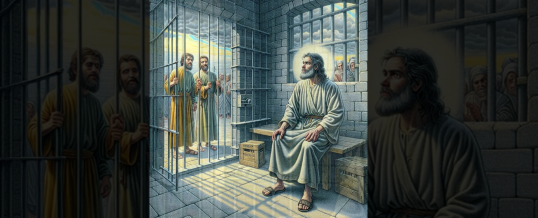
John the Baptist, even though Jesus calls him the greatest prophet, is finding his patience running thin. It’s difficult for him to remain hopeful in the hopeless situation he finds himself in—he’s in prison, he’s close to death, and there’s no indication his situation is about to get any better. In his discouragement, he sends a messenger to ask Jesus, “Are you the one who is to come, or are we to wait for another?”
In the beginning of Luke’s gospel, we were told that while John was still in the womb of his mother, Elizabeth, he leapt for joy just by being in the presence of Jesus who was in the womb of Mary. It’s like he had a unique superpower, a Spidey sense, to detect the long-awaited Messiah even before he was born. Now, he’s having doubts as he languishes in prison. Is he losing hope? Did he feel he dedicated his whole life to someone who isn’t the Messiah? Perhaps. His life was a compass pointing others to Jesus, God’s Word, walking among us. Now he appears to have lost his own way. His strong conviction and commitment to that Word is what got him in prison in the first place. He never wavered, until now, in his belief and passion about God’s Word. Yet, at this moment, he remains open to hear a word he desperately needs to hear again.
Although Jesus says that John the Baptist is the greatest of the prophets, for the first time we’re seeing cracks in his armour. He’s human, after all. I’m not scandalized by John’s imperfection, his doubts, any more than I was scandalized when I found out my parents weren’t perfect. Realizing that your hero in life needs to lean on a power greater than their own power is initially shocking but later admirable. John the Baptist, in his humility, always knew he needed Jesus’ encouraging words, but now he needs it even more. When John reached out with a question that can be perceived as offensive, “Are you the one who is to come?” he was really reaching out in faith. It’s like John is saying, “I can’t squeeze out from between these prison bars, but your word can still squeeze its way in.”
John, this one whom Jesus calls a messenger is still receiving messages. He is still keeping he ears and eyes open. He is still able to turn his attention beyond himself. He hears from Jesus’ messengers that “the blind receive their sight, the lame walk, the lepers are cleansed, the deaf hear, the dead are raised to new life, and the poor of the earth learn that God is on their side.” When John heard this, his hopes were revived, and he leapt for joy not in the confines of his mother’s womb but in the confines of his prison cell. He knew he would never leave physical captivity but, on hearing what the Messiah was up to, what chains must have fallen away and what light must have flooded his cell!
When John heard what the Messiah was doing, it makes me think of how important and powerful Christ’s words and our words can be to those in captivity. It makes me think of those imprisoned, of young people recruited into the sex trade, of those living with addictions, of those with little or no self-esteem, and of those trapped in loveless marriages. I think of those who have been robbed of power and those, for reasons of ignorance or an illusion of security, have given away their freedom little by little.
When John heard what the Messiah was doing, it makes me think of places of bondage within myself, of parts of my being that live with less freedom, less wholeness than God ever intended. I think of times when I’ve struggled within institutional systems or times I gave away my power. I recall situations that entangled me and exhausted me. It begs the question, how does God call me to live with freedom, hope, and trust in the One who came to set prisoners free?
When John heard what the Messiah was doing, it makes me think of all the places in peoples’ minds, souls, and spirits that live in confinement. What is one tiny step I can make in their direction to bring them inner freedom?
John may have been confused between his own expectations of a Messiah and who Jesus really was. He once told the crowd that the Messiah would come with an axe in hand and lay it to every tree that wasn’t bearing good fruit. Instead, Jesus came, not with an axe but holding a loaf of bread inviting all to come and eat, the rich, the poor, the worthy, and the “unworthy.” John the Baptist’s idea of the coming Messiah did not fit the picture of who Jesus actually was. However, he still kept seeking Jesus, inquiring about him, and longing for him to speak words of hope, truth and comfort.
John isn’t the superhero I had hoped for, but I’m not scandalized. In his humanness he is more than a Prophet. Jesus thought people might take offense at him because he wasn’t what a lot of people hoped for in a Messiah. I’m not scandalized by Jesus either. Thank goodness we don’t always get what we want. In Jesus we always get more. We might want an axe to divide; instead we get a loaf of bread to unite. His word heals, cleanses, liberates, and gives new life. Stay patient, be committed, and some day, as Isaiah told us, even the desert will bloom.
~Fr. Phil
DEC
2025
About the Author: