
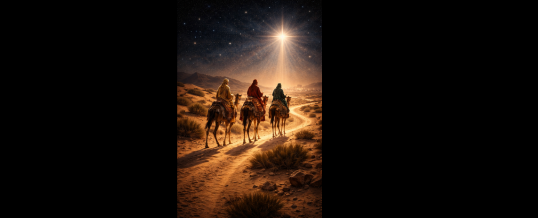
The readings we have today for the Feast of the Epiphany remind me of the word catholic (with a small “c”). The word catholic is not found in the Bible, by the way, but what it means is found everywhere in the Bible. Catholic means universal, inclusive, all-embracing. It was coined and applied to the Church around the year 110 by St. Ignatius of Antioch. If we are to keep calling ourselves the Catholic Church, then the challenge is to become, more and more, a church that is universal, inclusive, and all-embracing. The word “catholic” is not just an adjective; it’s a mission to be lived. I think all three readings today tell us so. Let’s take a look.
The prophet Isaiah speaks about a darkness that has covered the earth, a thick darkness over the people. He’s referring to the deportation of his fellow Jews to Babylon, where everything they valued was taken away from them. But this exile, after about 50 years, is about to come to an end. So, Isaiah says, “Arise, shine, for your light has come. God’s glory is appearing over you. Nations will come to your light.”
Isaiah is not just speaking about Jews being able to return to their homeland and how this causes them to rejoice. Isaiah also mentions all nations of the world being jealously attracted to God’s love for Judah and wanting more of it for themselves. It’s like moths being attracted to a porch light and attracting other moths in the process. What God has done for Judah, God will do for Midian, Ephah, Sheba and the entire world, including us right here. The point of the Jews being God’s Chosen People is not to sit in their chosen-ness and feel superior over others. The point of being God’s Chosen People is to communicate God’s chosen-ness to all the world. From here on in, everyone you meet is part of God’s Chosen People even though God initially used a specific people, in a specific place, and at a specific time in history to start with. It’s like Isaiah is telling his fellow Jews to live in such a way that their lives radiate God’s universal love.
Paul speaks about this catholic, this universal love of God, in a similar vein when he writes to the Ephesians. He says that there was a mystery, that until recently, was not made known to humankind. But now, the secret is out. This is it: the Gentiles (non-Jews) are part of the God’s salvific plan just as much as the Jews always were. Gentiles are part of the one and same body of believers as Jews are. Jesus is not just King of the Jews; he’s the King of the world. That’s the epiphany, that’s the revelation, Paul says. We are all sharers in the promises of Christ Jesus. There are no insiders and outsiders. There are no categories of “we” and “them.” In Jesus, there is only “us.” Catholic is not an adjective. It’s more a verb, an action word, a mission. Our mission is to bridge the gap between “we” and “them”, so that there is only the world of “us.” I can believe in Jesus Christ exclusively as my personal savior because his love is so inclusive. Nothing and no one is left out of his great love. If he’s like that, then my love as a Catholic also has to be like that—universal, big, all-inclusive.
Then we get to the gospel story of the journey of the Wise Men. Talk about a story of universality and the resistance against it.
Wise Men come from the East, most likely pagans from outside established Jewish territory. Although they are Gentiles, non-Jews, they are seekers of the truth. The truth, if we persist in seeking it, will always lead us to Jesus who is the Way, the Truth, and the Life. But this is a realistic story, so not everyone is interested in the truth. The story of Epiphany is a story of both acceptance and rejection. Everything that happens in the story of Epiphany will be a foreshadowing of where the next 33 years of Jesus’ life will go. Some will accept Jesus and follow him while others will reject him and want him dead.
The Wise Men follow a star. The star represents the heavenly realm. The baby represents the earthly realm. When the star lines up over the place where the child is born, heaven and earth will have come together. It’s like an a-ha moment in our own lives. We’ve all had them. We even say stuff like, “I feel like the stars are aligned at this moment of my life. Things are coming together. I’m not fighting things as much. I see the purpose of things now that I never saw before.” Or we say, “Things have come full circle. I’m back at the same point—the starting point—but it feels like I’m here for the first time. I feel renewed, energetic, like I have a new lease on life.” That’s Epiphany.
When we pray the Our Father and say, “May your kingdom come on earth as it is in heaven,” I think we are praying for the alignment of the star and the manger. There is nothing more universal than heaven. Our desire, when praying the Our Father, is to take that love of heaven and make it manifest on earth. In other words, our mission is to join the star to the manger, heaven to earth. These two realities, the realm of heaven and the realm of earth were always meant to be together.
It’s not easy putting the two together. In my dualistic mind, I pick and choose who I love on earth, all the while hoping that God will love other people someday, in heaven, that I could not love on earth. This kind of thinking does not bring heaven to earth; it does not align the star over the crib. The call in me is to become more catholic, more universal here and now.
This baby Jesus, who was laid in a food trough for animals, will grow up and say, “Whoever eats this bread will live forever; and the bread that I will give for the life of the world, is my flesh.” Am I life for the world?
Pagan Wise Men followed the star and discovered Jesus who is the embodiment of love for the entire world. When we persevere as they did in joining heaven and earth, we, too, will be overwhelmed with joy.
~Fr. Phil
JAN
2026
About the Author: