
In the secular world, we celebrate New Year’s on January 1st, but from a liturgical point of view, the first Sunday of Advent is the beginning of a new Church year. We say “good-bye” and “thank you” to the gospel writer Luke who has been our guide for the past year, and we buckle ourselves in and allow gospel writer Matthew to be our pilot for this new year.
The new liturgical year begins much in the same way as the old liturgical year ended, with mysterious and cryptic readings about the end-times and equally strange readings about Jesus’ second coming. It seems that Jesus’ return will not likely be in the form of a vulnerable baby but more like in power and glory. But, then again, we were caught unaware the first time around. The question is always the same: What could these bizarre readings possibly be telling us in these times we are living?
Along with John the Baptist and Mary, the prophet Isaiah always has something to tell us as we prepare for Christmas. In that first reading, he sees his Jewish people on the verge of destruction. They are supposed to be God’s Chosen People, which they are, yet they are about to be annihilated by an enemy county. It’s inevitable. It’s going to happen. But before it does happen, while Isaiah is in prayer—and it’s important that it’s said that way–God shows him a vision. In the vision, pain, suffering, destruction and death are coming to Israel, but it’s only a footnote to what is really coming. While still in prayer, it is revealed to Isaiah that God’s people will return from exile. Not only will the Jewish people, God’s Chosen People, be returned to Jerusalem, but all of God’s children worldwide will be gathered at the highest mountain where peace will finally reign. Swords, instruments of war, will be turned into ploughshares, instruments of farming. Death and destruction will be turned into planting and harvesting of new life. God and God’s plan for this world will ultimately be victorious. Destruction did come to Israel in Isaiah’s time, yet this prophet stayed awake his entire life to what God was doing in the midst of such a mess. Isaiah stayed awake and told others to do the same, thus becoming a prophet of hope.
We’ve had a lot of funerals lately, including a six-year-old girl and a couple of men who died suddenly. I’m sure for their loved ones, it’s like the world has come to an end. Yet, in the middle of their grief, we need to remind them during their hardest day, that God is still in charge. Like swords that are beaten and refashioned into ploughshares, their grief will also be refashioned into healing and peace that lasts forever.
Grieving or not, the invitation is for all of us to stay awake to what God is doing in our personal lives and in the life of the world. I get overwhelmed sometimes with the bad news I not only get from the media regarding worldwide events but also from the smaller circles I run in, like the struggle of family members and parishioners. I need to heed Isaiah’s message that “this too will pass.” Struggles have a shelf life; they don’t last forever. What doesn’t have a shelf life is Jesus who came in the flesh and who promised his Spirit, a presence that would never leave us. It’s that presence that I need to stay awake to and draw hope from.
Now, “staying awake” is easier said than done, but it is the stance we need to take during Advent and, I would add, all year round.
Paul, in that second reading, mentions staying awake and being alert using a different metaphor. He says, “put on the armour of light.” Who puts on armour? (Maybe you do when your mother-in-law shows up at the front door unexpected!). A soldier puts on armour. A soldier is always alert and ready for anything and everything. That’s what they are trained for. Paul says, “be like that.”
So, Paul gives us the metaphor of the soldier who stands on guard, and Jesus tells us to be alert to God’s actions in the world by using the metaphor of a thief. Since we do not know when the thief is coming, we are to be alert and awake at all times. It remind me of a college exam I was preparing for. The professor told us we will be asked to answer five questions on the final exam. Great, or so we thought. All we have to do is prepare for those five questions in advance and give the best answers to them on exam day. But there was a little twist. The professor gave us eight questions to ponder in advance, five of which would show up on the final exam. Which five? We had no idea. It was up to the professor’s whim. So, in the end, we had to prepare for everything.
Be prepared, be ready, be open to God’s initiatives breaking into your life. That seems to be the message of the gospel. Two men are doing exactly the same thing—working in the field. One is taken while the other is left behind. Two women are doing exactly the same thing—grinding wheat at a mill. One is taken while the other is left behind. On the outside, there’s no difference between these two men and nothing to distinguish one of these women from the other. The difference must be interior. It must be on the level of awareness. One was awake, interiorly, to what God was about in their personal life and in the life of the world; the other was asleep. Similarly, in the time of Noah, people were doing the daily stuff of life—eating, drinking, getting married, etc. They did these ordinary things without any reference or awareness of God and were completely taken by surprise when the Flood came. Noah wasn’t caught off guard. He was prepared, because he lived his life with an awareness of God even in the menial and boring tasks of his life.
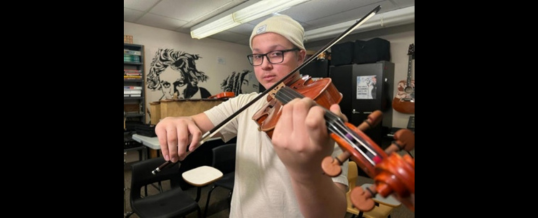
This reminds me of Daniel Milliea, a 16-year-old young man from Elsipogtog First Nation only an hour’s drive from here. You may have seen his story on the news this past week. He, like many children, honed his craft at learning to play an instrument with the help of the Systema music program. His commitment and hard work has earned him the opportunity to showcase his skills at the prestigious Carnegie Hall in New York City this December 20th. His instructor shared a story about how one day Daniel asked permission to be late for one of his lessons. The reason he gave was very interesting and very telling. He was going to be late because he needed to pray beforehand. Before the music comes the prayer. But he’s not just thinking about himself and what he needs to do for his own personal preparation. He’s also thinking of others. Daniel says, “My community is going through a lot and seeing me at Carnegie Hall will put warmth in their hearts.” This young man is aware of God and the needs of his community.
Paul once wrote in a letter to the Thessalonians, “Pray constantly” (1 Thes. 5:17). He didn’t mean that we were to spend all our time in prayer. He meant that whatever you do, do it with an awareness of God. This young musician from Elsipogtog plays music with an awareness of God. I have a feeling he does everything with an awareness of God. He seems to be working the field and grinding meal like everyone else, but underneath it all, something more is going on in this young man. Let’s try to be more like him this Advent and keep awake.
~Fr. Phil
DEC
2025

About the Author: