
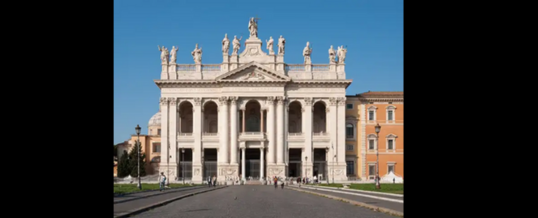
Every seventh year, more or less, November 9th lands on a Sunday. November 9th is the feast of the dedication of a church building in Rome called St. John Lateran. It’s kind of unique, because every other feast in the Church centers around the life of a saint or some important event in the life of Jesus or Mary, like the great feasts of Christmas or Easter. So, why have a feast involving a building, especially when Jesus passionately said, “Destroy this temple, and in three days I will raise it up”?
A little context. As you know, in Jesus’ time and for the next 300 years afterwards, the Roman Empire with its emperor, whom the Romans considered divine, ruled the world. Professing faith in Jesus or getting caught praying publicly to the one, true God assuredly meant persecution and death. Both Saints Peter and Paul met their deaths in Rome along with many other martyrs during those first 300 years. The Christian faith is still persecuted in countries like Saudi Arabia and is practiced only in secret at great risk to those who do so.
However, in 318 A.D. Roman emperor Constantine had a “conversion” experience and became Christian. Whether it was a real conversion or not is highly debatable. Nevertheless, following his conversion, Christianity was no longer a persecuted religion. People were now free to worship publicly rather than having to do so secretly in homes, barns, cemeteries or catacombs. Emperor Constantine, in 324, gave Christians one of the Roman palaces which was transformed into a church building. This building was dedicated and named after both St. John the Baptist and St. John the Evangelist. It was on land once owned by rich Italians whose last name was Laterani, thus the church became known as St. John Lateran. It was Christianity’s first public building; the Church had a church for the first time. St. John Lateran is the mother church of the diocese of Rome, and the mother church for Catholics throughout the world, not St. Peter’s Basilica as a lot of people might think.
Over the years, I’ve learned not to get too attached to buildings, especially church buildings. Maybe it’s because we priests get transferred from here to there yet the community continues on worshipping in the same building year after year, sometimes from generation to generation. While I don’t get attached to buildings, I can see how a place to call home grounds people. You might move a lot in your lifetime, but the place you were baptized, or where you made your First Communion, or where you were married in, or where your parents were buried from, still holds significance. And maybe that’s why pilgrims journey to sacred sites or to cemeteries…there something sacred still lingering there. Something happened there that made a significant claim on their lives.
Having said all that, the gospel tells us that when Jesus spoke about destroying the Temple, he wasn’t talking about the building per se. He wanted the building to remain and become what it was always meant to be—his Father’s house, rather that the marketplace money makers had turned it into. We know that Jesus was referring to his own death and resurrection when he talked about destroying the temple and raising it up again. The temple was his own body. Paul makes the same point, using slightly different language, when he says to us, “Don’t you know that you are God’s temple and that God dwells within you?” When Paul says, “you are God’s temple,” I think “you” refers to you as the individual. You carry divine DNA within you. You are sacred, every part of you even and including the parts you would prefer to change in an instant, if you could. I also think the “you” Paul refers to when he says, “you are God’s temple” is the collective you. It’s the Church, the people of God he’s speaking about. We ourselves are unfinished temples. Here’s a story about the Church, although it never mentions the word Church. It reminds me of the living water that flowed from the Temple that Ezekiel spoke about in that first reading. Wherever the water went it caused abundant life to emerge.
There is a story that an artesian well had sprung up in the middle of the desert, and it was a marvelous well with clear, nourishing, and copious water. People began to come and to drink and to celebrate their wonderful discovery of a well in the desert. Gradually they built a building over the well. They walled it off. They developed ceremonies to celebrate their good fortune of finding an oasis in the desert. They wrote official versions of how it was discovered. They spun fantastic tales about the effects of the water. But the water, actually, over the next few months, had ceased to flow. But hardly anyone noticed that the water wasn’t flowing anymore, that it begun to diminish and finally it went away. They were so busy building and maintaining the super structure. The water took itself over and burrowed a new channel in the desert, which was just as good, clear and nourishing and life-giving in a totally new and unexpected place. A new group of people found it there and they were also refreshed. But the old group of people just kept telling the story back at the old well, kept maintaining the wall, kept maintaining the building over the well, and actually forgot to realize that the water wasn’t there anymore.
Personally, I don’t think most of our people, both regulars and those who never come to Mass, are accessing the well. And because some of them never drank from the well, they don’t even know they are missing it. And we just keep maintaining the wall around the well, the building over the well, the stories about the well, singing songs of people who once drank at the well. Every one of us has to want the water, not just the container that holds the water. Jesus says that if we drink of the water he wants to give us, we will never thirst again. Only in that context does this feast honoring the dedication of a church in Rome make sense. The church building points us to the living Church, the people who thirst for living water. Our mission, like Jesus’ mission, is to quench the thirst of those around us, for we are that same living water that Jesus continues to be.
~Fr. Phil
NOV
2025
About the Author: