
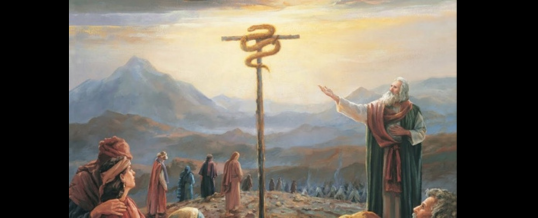
In the first reading God instructs Moses to make a bronze serpent and to put it high on a pole for everyone to see. The gospel makes reference to this event by saying, “Just as Moses lifted up the serpent in the wilderness, so must the Son of Man be lifted up.” What are we to make of all this lifting up business and the snake? Personally, when I see a snake, I run in the opposite direction. These scripture passages are telling me to do the contrary, not to run but to stay put.
Because of their continuous complaining, as they journeyed through the desert for 40 years, God sent poisonous snakes to bite the Hebrews, at least the complainers in the group. Some people, we are told, even died. When they regretted all the complaining they had done, they asked Moses to tell God to cool it with the snake biting as they had learned their lesson. So, God relents with the poisonous snakes but instead of sending an anti-venom, God does something more bizarre and more perplexing. God asks Moses to make a bronze snake and to attach it high on a pole for everyone to see. Anyone who was bitten by a real snake was to look at this bronze snake and they would be healed. It seems that the thing that caused them pain, and even death in some cases, was the very thing they were not to run from but to gaze up at. It beckons these questions in my own life: Do I run from the things, in my life, that cause me pain and anxiety? Do I trust enough to believe that God is there not only accompanying me in my pain but also bringing me healing?
Again I think of many courageous people who are seriously trying to fight an addiction. I don’t know if I would have the guts to face the demon, the serpent, the thing that continually bites me that these people face in the 12-step program they are in. Those who can face their addictions straight on, with lots of honesty and humility, in the end have their lives transformed. It’s like they were once dead but now they are alive. They no longer run from the thing that previously caused them pain but put their pain in the hands of a “higher power,” what we would call God.
If this is true for people in 12-step programs like Alcoholics Anonymous or Gamblers Anonymous, it’s also true of anything that causes us pain like a broken marriage, failing health, a relationship that has soured, or a dream that is suddenly crushed. Pain is pain, no matter what form it comes in. While pain is universal, our personal pain is unique.
St. Paul tells us, in that second reading, that Jesus did everything to avoid being exempt from the pain that every human being feels at one time or another. Every one of us, inside these four walls, is carrying a pain right now. And the good news is that Jesus did not cling to his equality with God but emptied himself of everything divine so as to be able to enter fully into your pain and my pain, the pain that comes along with being human.
Divine reality, by its very nature, overflows and pours itself out. In other words, there’s nothing in God that clings to itself. If God does not cling to God’s self, then Jesus doesn’t cling to himself either. Clinging and equality to God is a contradiction. Not only does Jesus not cling to his own life, but he freely lays down his life. Jesus said at the Last Supper, “No one take my life from me; I lay it down of my own free will. I have the power to lay it down, and I have the power to take it up again” (Jn. 10:18).
Can we believe that God has no vested interest in punishing us or pointing an accusing finger at us, but that God’s only agenda was to send his only-begotten Son in order that the world might be saved through him? Can we take our little pain, which is real and often debilitating, and place it into the hands of the one whose pain transformed the world? Can we believe in a Jesus who, because he didn’t run from his own pain was transformed from the dead Jesus into the resurrected Lord?
Picture yourself before the crucified Jesus and recognize that he became what we are all afraid of and what we all deny: nakedness, exposure, vulnerability and failure. He becomes “sin” to free us from sin, the cosmic Scapegoat who reveals our worst and our best souls to those who will gaze long enough. He became the crucified so that we could stop crucifying. He became the crucified who refused to crucify back, thus, breaking the pattern of death.
I offer this prayer, once again borrowing from Fr. Richard Rohr. It’s Jesus speaking from the cross and us speaking back to Jesus.
Jesus speaks: “My people, I am yourself. I am your beauty. I am your goodness which you are destroying. I am what you do to what you should love. I am what you’re afraid of, your deepest and your best and your most naked self. Your badness largely consists in what you do to your goodness, your own and others—and that is indeed bad. You are afraid of the good. You are afraid of me. You kill what you should love. You hate and fear the very thing that could and will transform you. I am Jesus crucified. I am yourself. And I am all of human history.
We speak back to Jesus: “I thank you, Lord Jesus, for becoming a human being so I do not have to pretend or try to be God. I thank you, Lord Jesus, for becoming finite and limited so I don’t have to pretend that I am infinite and limitless. I thank you, crucified God, for becoming mortal so I do not have to try to make myself immortal. I thank you, Lord Jesus, for becoming inferior so I do not have to pretend that I am superior to anyone. I thank you for being crucified outside the walls, for being expelled and excluded like the sinners, so you can meet me where I feel that I am, always outside the walls of holiness.
“I thank you for becoming weak, so I don’t have to be strong. I thank you for being willing to be considered imperfect and strange, so I don’t have to be perfect and normal. I thank you, Lord Jesus, for being willing to be disapproved of, so I don’t have to try so hard to be approved of and liked. I thank you for being considered a failure, so I do not have to give my life trying to pretend I’m a success. I thank you for being wrong by the standards of religion and state, so I do not have to be right anywhere.
“I thank you for being poor in every way, so I do not have to be rich in any way. I thank you, Lord Jesus, for being all the things that humanity despises and fears, so I can accept myself and others in you. So I can love in you that very part of me that I most hate.
“Crucified Jesus, I thank you for becoming a human being. Lord Jesus crucified, you and I are the same.”
~Fr. Phil
SEP
2025
About the Author: