
Alongside the four seasons in nature the Church also, as you know, marks time with seasons such as Lent, Easter, Ordinary Time, Advent, and Christmas. Not as well known is the Season of Creation celebrated annually and ecumenically from September 1st to October 4th, the Feast of St. Francis of Assisi. The first Season of Creation was celebrated starting from September 1, 1989, when Ecumenical Patriarch Dimitrios l proclaimed it as the Orthodox Day of Prayer for Creation. It has since been extended to the World Day of Prayer for the Care of Creation.
The theme for this year’s Season of Creation is “Peace with Creation.” This special time is given to us to renew our relationship to God through celebration, conversion, and commitment together. It’s our chance to respond to the cry of creation.
As I’m typing this, there are currently 33 wildfires burning in our little province of New Brunswick. Climate change has never felt so real nor so close as it does to me now. Talk about the cry of creation! Do we hear it? What will be our response? What is our Christian faith calling us to during these times?
Over 700 years before the birth of Jesus, the prophet Isaiah wrote, “…until a spirit from on high is poured out on us, and the wilderness becomes a fruitful field, and the fruitful field is deemed a forest. Then justice will dwell in the wilderness, and righteousness abide in the fruitful field. The effect of righteousness will be peace, and the result of righteousness, quietness and trust forever. My people will abide in a peaceful habitation, in secure dwellings, and in quiet resting places” (Is. 32:14-18).
Isaiah pictured a desolated creation without peace because of a lack of justice and brokenness between God and humanity. He knew then (2700 years ago) that our behavior does, indeed, impact the health (or sickness) of the earth. I’m sure he would be shocked if he could see the world now. Isaiah was a not a doom and gloom prophet, but he called people to open their eyes to the truth. He saw hope then, and we still need to see hope now for our broken and bruised planet.
While we are never without hope, hope doesn’t mean—in a Biblical sense –sitting on our hands and wishing for a better world. Biblical hope always asks us to act, to pray, to change, and to reconcile with creation and the Creator in unity.
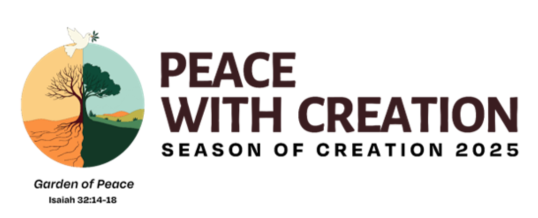
If you look at the symbol, the logo for this year’s Season of Creation, you will notice the dove at the top. It recalls the story of Noah and the Great Flood (read Genesis 6: 5 onward). You’ll recall from this story that the dove was a messenger. It returns to the ark with an olive branch in its beak signalling that the flood was receding. (The dove to this day is seen as a symbol of hope and peace, of better days to come). The Flood story, however, begins with, “God saw that human wickedness was great on earth…” (Gen. 6:5). Something was not right, yet the dove was the bearer of hope.
The dove is the Christian symbol of God’s Spirit. We are told that when Jesus was baptized in the River Jordan, the Holy Spirit descended upon him like a dove. Isaiah said (see the above quote) that the spirit from on high will be poured out on us.
There is a huge cost, not to mention ecological destruction, placed on the shoulders of the most vulnerable people on this earth we call home. There can be no peace without justice and one of the most unjust realities is the huge level of debt owed by poor and vulnerable countries to rich countries. These poor countries have suffered the most from climate change even though they have done the least to cause it. Force to take out loans to build back from climate disasters, they become further entrapped in debt. How far this seems to be from the gospel (the good news) that Jesus and the prophets came to proclaim.
I invite you to go to seasonofcreation.org for updates and concrete ideas of how to live this special Season of Creation we are given.
~Fr. Phil
AUG
2025
About the Author: