
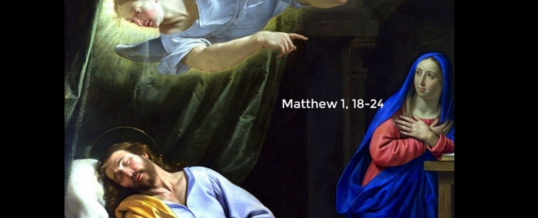
Once again, the readings the Church asigned us have a common thread between the first reading and the gospel reading. Each is about a man who finds himself in a dilemma. King Ahaz, in that first reading, deals with the dilemna poorly while Joseph, in the gospel, handles his predicament much better. Let’s look at these two contrasting guys and see what God might be saying to us .
Firstly, let’s look at King Ahaz who …
 by admin
The readings we have today for the Feast of the Epiphany remind me of the word catholic (with a small “c”). The word catholic is not found in the Bible, by the way, but what it means is found everywhere in the Bible. Catholic means universal, inclusive, all-embracing. It was coined and applied to the Church around the year 110 by St. Ignatius of Antioch. If we are to keep calling ourselves the Catholic Church, then the challenge is …
by admin 
All three readings, proclaimed worldwide by the Church today, remind me of the saying, “the seed never sees it’s flower.” If we take it literally, the seed is underground, so it naturally can’t see the blossom above ground. But more to the point, the seed (unless it is a bulb) must die long before the plant ever produces a shoot, a stem, or a flower. The metaphor is true for humans as well. Some of our greatest efforts will …
by admin 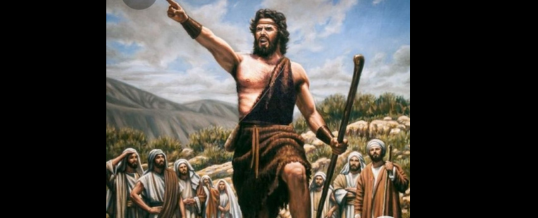
John the Baptist appeared in the wilderness. We are not told how he got there. He just suddenly appears, which automatically moves our minds to mystery. A mystery is about to unfold, and it’s about to unfold in the desert of all places. Cities, like Jerusalem, are where the hustle and bustle of life happens. And just like us, people were going to the desert to escape the rat race that life can often turn into. I think they …
by admin 
In the secular world, we celebrate New Year’s on January 1st, but from a liturgical point of view, the first Sunday of Advent is the beginning of a new Church year. We say “good-bye” and “thank you” to the gospel writer Luke who has been our guide for the past year, and we buckle ourselves in and allow gospel writer Matthew to be our pilot for this new year.
The new liturgical year begins much in …
by admin 
\This solemnity of Christ the King of the Universe was first celebrated 100 years ago. In 1925 the world was rebuilding after the end of World War I, Italy was run by a fascist dictator, and the Church had lost much of its political power. In the background of such chaos and upheaval, Pope Pius X, chose to establish the Feast of Christ the King. He didn’t simply want to write an encyclical that most people wouldn’t read. He …
by admin 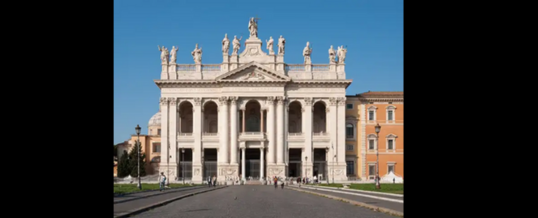
Every seventh year, more or less, November 9th lands on a Sunday. November 9th is the feast of the dedication of a church building in Rome called St. John Lateran. It’s kind of unique, because every other feast in the Church centers around the life of a saint or some important event in the life of Jesus or Mary, like the great feasts of Christmas or Easter. So, why have a feast involving a building, especially when Jesus passionately …
by admin 
That first reading from the Book of Lamentations, Scripture scholars don’t know who wrote it. Their best guess is that the Prophet Jeremiah wrote it. It starts off quite depressing; that’s probably why it’s called “lamentations.” It’s the year 586 B.C.E., and Jeremiah is looking at the once-beautiful city of Jerusalem now in ruins. The Babylonians have invaded and took over the country of Judah destroying everything in their path including the capital city of Jerusalem and the sacred …
by admin 
When it comes to good storytelling, usually the storyteller tells the story and then gives the meaning only afterwards. In between we’re supposed to try and see how the story connects with our lives. But like last Sunday’s gospel, Luke again breaks storytelling rules by giving us the meaning and then tells us the story. The opening line says that Jesus told this parable to some who trusted in themselves that they were righteous and regarded others with contempt. …
by admin 
Usually, in the world of storytelling, the storyteller tells a story or a parable, has the listeners puzzle the story in their mind for a while, and then the storyteller gives the lesson. Just this one time, though, our storyteller, Luke, does it the opposite way. He gives the meaning before the story. This is not a good way of telling a story by giving the meaning ahead of time. It pre-empts the listeners’ response to the story by …
by admin